


In this article, you’ll learn why a handpan goes out of tune and what you can do to maintain its tuning stability for as long as possible. You’ll also find practical, easy-to-follow tips on how to prevent your instrument from going out of tune so you can enjoy playing it for years to come.

Tuning stability refers to how long a handpan retains its original tuning. In other words, it describes whether the clear, pleasant tones carefully tuned by the handpan maker remain stable over time. Simply put, a C note should continue to sound like a C, an F♯ should remain an F♯, and so on.
A handpan is considered to have good tuning stability if, with proper use and care, its tuning does not change for at least two to four years. The actual duration depends on the manufacturer. In general, inexpensive mass-produced handpans may go out of tune within a year, while high-quality instruments can maintain their tuning for decades or even a lifetime.
A well-tuned handpan produces a clear, rich sound characterized by harmonious overtones, allowing all the notes of the scale to blend beautifully together.
When a handpan goes out of tune, the notes lose their clarity and their frequencies shift. As a result, the instrument begins to sound dull and dissonant, disrupting its characteristic resonance and beautiful tone. An out-of-tune handpan simply becomes unpleasant to listen to.
The more stable your handpan’s tuning is, the better your playing experience will be and the fewer issues you’ll encounter with your instrument. A handpan that frequently requires retuning can become frustrating to own and takes away from the immersive, enjoyable experience of playing.
If your handpan has gone out of tune, you’ll most likely hear it. It won’t sound as beautiful as before something will seem off. The notes will lose their harmony, and the instrument simply won’t be as pleasant to listen to.
To accurately identify which notes are out of tune and by how much, you’ll need professional measuring tools.
A handpan’s tuning is commonly checked using a standard chromatic tuner, available from most music stores. Alternatively, a smartphone tuning app is perfectly suitable for this purpose. Both tuners and apps measure the frequency of each note, since every musical note (C, D♯, G♯, etc.) corresponds to a specific frequency.
However, checking a handpan with a standard tuner is not as simple as it seems. A regular tuner can only measure one frequency at a time, while each handpan note contains three different frequencies. For the note to sound good, all three must be in tune. This means each note has to be checked three times, and you also need to know which harmonic frequencies belong to that note. Checking only the main note is not enough.
Each note should be played gently and individually while its pitch is measured with the tuner.
Tuning accuracy is measured in cents (cts.). For handpans, a deviation of 5–10 cents is generally considered acceptable.
This means that if a note for example, C—is within 5-8 cents of its target pitch, the handpan is considered to be properly tuned.
If the deviation exceeds 20–30 cents, the handpan is regarded as being out of tune.
You can also perform an interference test, commonly known as the “wobble” test.
When a note is perfectly tuned, its fundamental frequency, octave, and fifth resonate together smoothly, creating a clean, even sustain. If you hear a pulsing or “wobbly” effect, it does not always mean that the note is out of tune. This can also be caused by an imbalance in the tone field, when the two sides of the note do not have the same tension. One side may be looser than the other, which can help achieve the correct pitch, but the note will not sound clean, stable, or balanced.
Instead of relying solely on a tuner, you can also trust your ears and your intuition. In some cases, an instrument may be technically out of tune without producing a noticeably unpleasant sound. Play each note individually, then try a few simple chords or scales. If the instrument still sounds beautiful and enjoyable to listen to, retuning may not be necessary.

The answer depends on the manufacturer, the quality of the instrument, and how often and how it is played.
A lower-priced handpan (typically under $1,000) may go out of tune within just a few months. These instruments are generally less durable and can lose their tuning even through normal playing.
There is also a significant chance that inexpensive handpans ordered from Chinese online marketplaces arrive poorly tuned from the factory. As a result, they may already sound out of tune the very first time they are played—something an experienced musician, or even a non-musician with a good ear, will notice immediately.
A premium-quality handpan, on the other hand, typically maintains its tuning for 2–5 years.
Some instruments offer even greater tuning stability. For example, MAG Handpans are tuned for life, which is why we provide a lifetime warranty on them.
Over time, every musical instrument—including a handpan—will eventually go out of tune. This is a natural process that cannot be completely avoided due to the laws of physics.
With instruments such as guitars or pianos, tuning changes are caused by the strings gradually losing tension.
A handpan, however, is made entirely of steel, so it may seem much more stable at first glance. In reality, the body of the instrument and each individual tone field gradually lose some of their tension over time. As the molecular structure of the steel naturally relaxes and seeks a lower-stress state, the tuning slowly begins to change.
How the instrument is handled and maintained has a significant impact on its tuning stability.
While a high-quality instrument and proper care can greatly delay this process, even the finest handpans will eventually require professional retuning every few years.
Steel expands when heated and contracts when cooled. Prolonged exposure to direct sunlight or excessive heat—such as leaving the instrument inside a hot car during summer or placing it near a radiator—can deform the steel and affect the tuning. However, a well-tuned handpan can usually recover from heat-related detuning, and the notes can return to their original pitch once the instrument cools back down to normal temperature.
Even relatively minor knocks or accidentally dropping the instrument can create microscopic dents that immediately disrupt the precise harmonic balance of the tone fields.
Striking the handpan too forcefully, hitting it with the palm, or using improper finger technique can physically push the steel out of its carefully tensioned shape.
Using drumsticks, mallets, or other striking tools can damage the tone fields. Handpans are specifically designed to be played with the hands.
Oxidation can affect the steel over a long period of time, especially if rust develops and the metal begins to deteriorate. However, normal surface discoloration on a well-made handpan does not affect the tuning or sound of the instrument. Proper maintenance is still important, especially if you frequently play near water, such as at the seaside.
Condensation can also form on the instrument when it is moved quickly between environments with different temperatures, for example, taking it from a warm house outside during winter. Wiping the instrument dry and allowing it to adjust gradually to temperature changes helps protect the steel.
Inexpensive instruments that have not been properly heat-treated or stress-relieved are far more likely to lose their tuning rapidly, sometimes within only a few months.
Attempting to retune a handpan yourself without the proper tools, techniques, and expertise can permanently damage the instrument’s tuning.
Models with a very high number of notes (for example, 17-note handpans) have tone fields positioned much closer together. This creates greater internal stress and increases the risk of sympathetic interference and tuning instability.
Unusual situations—such as someone sitting on the instrument—can permanently deform the shell. Damage of this kind is generally irreversible and cannot be repaired through retuning.


Around 99% of all musical instruments, regardless of quality, eventually require retuning.
MAG Handpans belong to the remaining 1%.
Our MAG Handpans are Tuned for Life, which is why every instrument purchased after March 15, 2026 is covered by our Lifetime Retuning Warranty.
We understand that this may sound hard to believe at first, but we have complete confidence in the craftsmanship behind every instrument we build.
That’s why we guarantee that your MAG Handpan will never go out of tune. If it ever does, we’ll retune it free of charge.
This warranty is unique even by international standards.
Each MAG Handpan is handcrafted by our skilled makers, delivering exceptional sound quality and lasting reliability.
Retuning a handpan requires expertise and experience. Whenever possible, it is best to have the instrument retuned by the original maker, as different handpan makers use different materials and manufacturing techniques. A tuner who is skilled at working on one type of handpan may not always be able to properly retune another maker’s instrument.
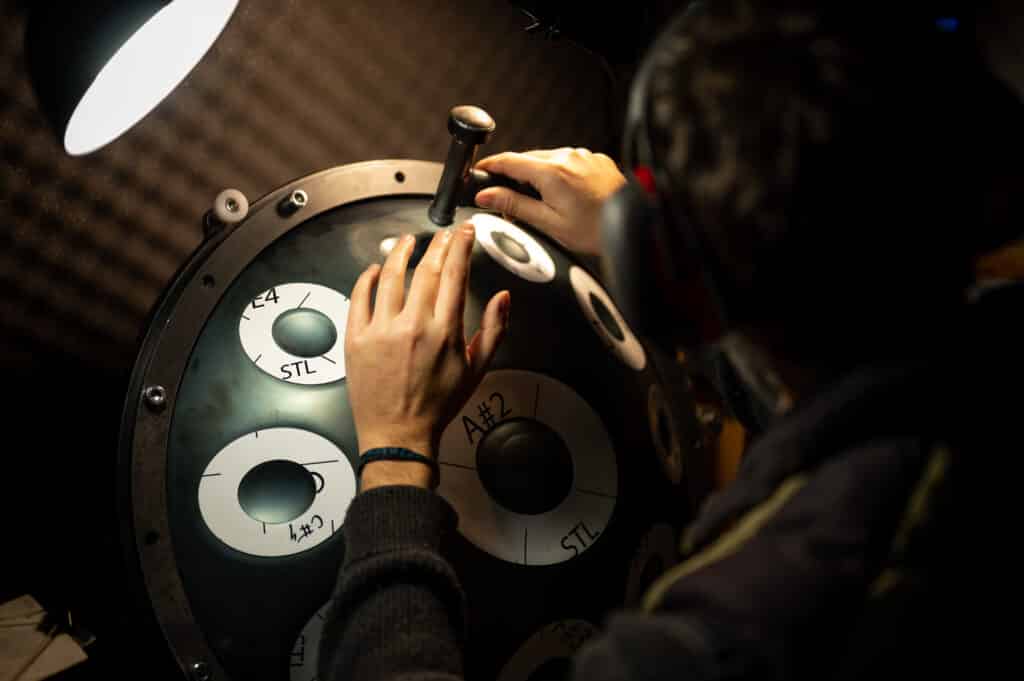
The first step is to identify which tone field has shifted and how much it is out of tune. This can be done using a chromatic tuner or tuning software. The actual retuning process involves carefully adjusting the individual tone fields with a tuning hammer.
Only very small adjustments should be made, as applying too much force can affect the balance of the instrument, damage the sound quality, or even make the tuning worse. In some cases, retuning can be a complex and time-consuming process, and an incorrect approach may require even more work to restore the instrument.
If you have no experience with handpan tuning, it’s best to leave the job to a qualified professional. Attempting to retune the instrument yourself can easily cause more damage than the money you might save.
Professional handpan retuning typically costs $150–200 / €150–200 per tone field.
Tuning stability is one of the most important factors affecting the playing experience and is also a reliable indicator of an instrument’s overall quality and beautiful sound.
MAG Handpans are built to last a lifetime and we truly stand behind that promise. Every handpan crafted after May 15, 2026, comes with our Lifetime Warranty, with no exceptions.
Because a handpan is more than just a musical instrument—it’s a companion that brings the joy of music into your everyday life.
To make sure we’re displaying the right prices for our instruments, please confirm your location.
