


Pygmy is one of the oldest handpan scales in existence and it has remained a firm favourite for over two decades. Today, there are several handpan makers creating a wide variety of instruments in this scale.
MAG Instruments is actively producing 4 version of the Pygmy scale: the F#2 Pygmy, the F Pygmy, the F# Pygmy and the C# Pygmy – all with different musical characters and flavors.
Let’s dive into the mysteries of the Pygmy!

The Pygmy scale takes its name from the music traditions of the Pygmy peoples of Central Africa — groups including the Bayaka, Mbuti, and Batwa — whose vocal and percussion music is known for its deep rhythmic complexity and circular, meditative character.
The name was attached to the handpan by PANArt when they built some of the earliest Hang instruments in the Pygmy tuning, around 2002 to 2005. Whether the scale has a direct harmonic connection to traditional Pygmy music is debated, the temperament systems differ, but the association with something primal, earthy, and ancient has stayed. It suits the sound well.
Pygmy is a pentatonic scale. It contains five distinct notes per octave, not seven. Specifically, it is a minor pentatonic scale, without the missing notes of the full minor scale it can be used as a dorian pentatonic scale as well.
The five core notes of the scale in any given key are: 1 – 2 – min3 – 5 – min7
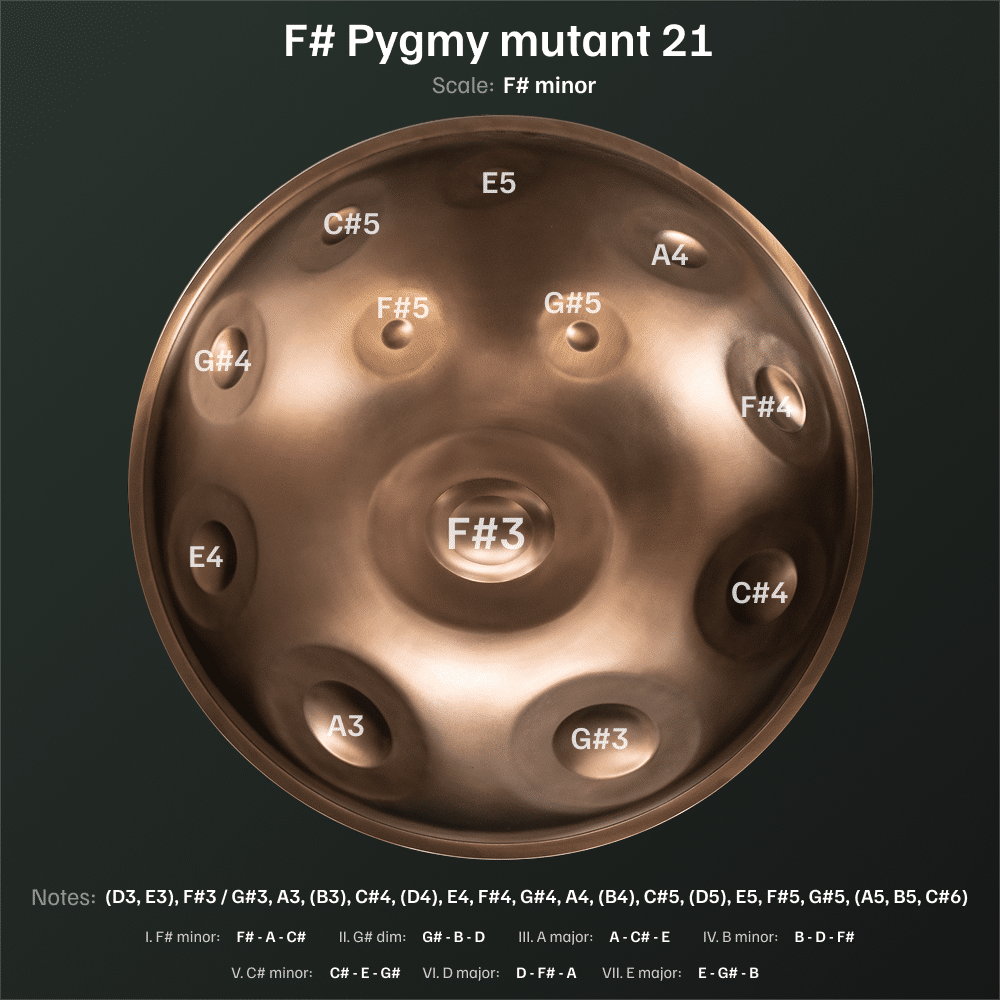
In a concrete example: the F# Pygmy, one of the most common Pygmy configurations, the notes are:
F# – G# – A – C# – E
Degrees: 1 – 2 – min3 – 5 – min7
On a standard 9-note handpan, the Ding (centre note) sits at F#, with the five scale tones arranged around the outer circle and repeated across octaves to fill the note fields.
One distinctive structural feature of Pygmy is that, unlike Kurd or Amara, the outer circle begins with a second interval above the Ding, not a fifth. This gives the scale a slightly chromatic, open feel from the very first notes you play together.
Because only five notes are present, MAG can spread them across a wider pitch range than a seven-note scale would allow. This is why Pygmy handpans often have a broader low-to-high span than an equivalent D Kurd, fewer notes, more octave space.
Pygmy has qualities that are genuinely difficult to find in other handpan scales.
The most striking thing is its consonance. With only five notes in the scale, and those notes arranged so that they outline a single consistent chord across all positions, almost any combination of notes sounds harmonious. Two notes struck together, three notes ringing simultaneously, a fast improvised pattern the Pygmy absorbs it all without producing dissonance. This is a rare thing, as most scales have at least a few note combinations that create tension.
The emotional character is best described as eerie yet hopeful, but unlike purely melancholic scales, Pygmy carries an undercurrent of openness that prevents it from feeling heavy. Players often describe it as meditative without being sleepy, and emotional without being sad.
The Dorian quality (that balance between minor and major) is part of what creates this effect. The scale is not fully minor. It sits in between, which gives it an ambiguity that a straightforward natural minor scale like D Kurd does not have.
Played slowly, with sustained notes allowed to bloom and overlap, Pygmy produces long, resonant waves of sound that suit meditation, sound healing, and yoga contexts exceptionally well.
Played rhythmically, it becomes hypnotic and groove-driven. The reduced note set means your hands naturally fall into patterns and cycles, and the circular layout of the outer notes encourages rhythmic repetition. This is where Pygmy’s percussive side emerges, something tribal and energetic, completely different from its meditative face.
Played freely and improvisationally, it is probably the most forgiving handpan scale there is. Because virtually every note combination sounds good, Pygmy is almost impossible to play “wrongly” in the traditional sense. This is a significant advantage for players who want to focus on rhythm and feel rather than melodic precision.
The pentatonic scale is one of the oldest tonal arrangements in human music. It appears across cultures and throughout history: in West African drumming, Scottish folk music, Japanese classical music, blues, and pop. There is something about the five-note structure that feels universal and immediately recognisable at a deep level.
The reason Pygmy resonates so strongly is partly this: when you hear it, your ear already knows it. Not because you have heard a handpan before, but because pentatonic intervals are embedded in music across every tradition you have ever encountered.
The specific Dorian pentatonic version, which is what Pygmy is, adds one further quality: the raised sixth degree compared to a natural minor pentatonic gives the scale a slightly brighter, more open quality. It is not the blues pentatonic (which is rawer), nor the major pentatonic (which is cheerful). Dorian pentatonic sits in a unique emotional middle ground that is expressive without being melodramatic.
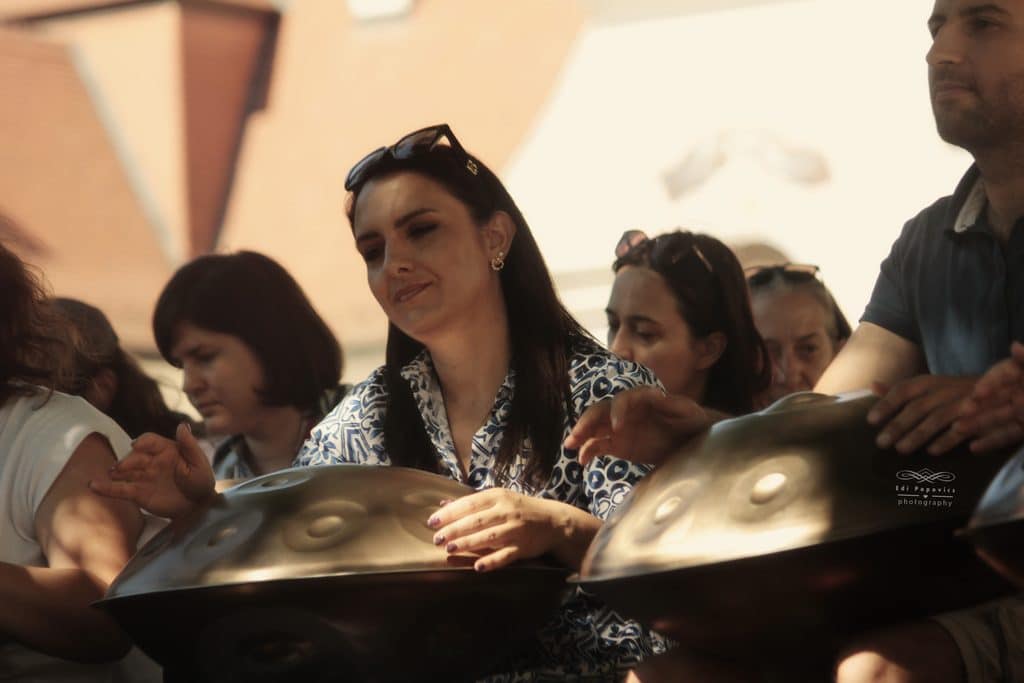
D Kurd is diatonic and fully seven-note: it gives you more melodic range, more chord options, and more harmonic complexity. Pygmy is pentatonic: it gives you more consonance, a wider pitch span, and a more meditative, rhythmically focused character. Kurd is the better choice for players who want to learn melodies and explore harmony. Pygmy is the better choice for players drawn to groove, improvisation, and sound healing.
The Amara scale (also called Celtic or Annaziska in some variations) is a hexatonic minor scale: six notes, sitting between Pygmy’s five and Kurd’s seven. It has a folk-influenced, flowing quality. Pygmy is earthier, more rhythmic, and more immediately consonant.
This depends on what kind of player you want to be.
If you want to learn melodies, work through structured exercises, and follow video tutorials, Pygmy is not the ideal starting point. The pentatonic structure means fewer instructional resources exist for it compared to D Kurd, and the scale’s strength in improvisation is less useful when you are trying to learn a specific song.
If you are drawn to improvisation, meditation, rhythm-based playing, or sound healing, Pygmy is an exceptional choice, even as a first instrument. The high consonance of the scale means you can pick it up and immediately create something that sounds cohesive, without any prior musical training. Almost all handpan schools use D Kurd for group classes precisely because its diatonic structure is easier to teach, but for solo, self-directed playing, Pygmy’s ease of improvisation is a genuine advantage.
One practical consideration: Pygmy handpans with many high notes, particularly the extended Mutant versions, can be physically demanding to play well.
The upper note fields on a Pygmy layout are closer together and require more precise striking. For beginners, a standard 9-note or 10-note Pygmy in C# or F is a more approachable configuration than a complex Mutant version.
MAG produces Pygmy handpans in several root notes, each with a slightly different character:
C# Pygmy 17 is probably the most beloved configuration. The C# root gives it a warm, grounded quality, not too high, not too deep, that works equally well for meditative and rhythmic playing. At MAG, it’s available in a 17-note version.
F Pygmy 16 and 20 sits a little higher, giving it a slightly brighter, more resonant quality compared to the C# version. At MAG, the F Pygmy is available in a 16 and an extended, 20-note version for more versatility.
F# Pygmy 21 is a truly colorful Pygmy scale giving experienced players a remarkably broad musical canvas. It is not recommended for beginners, however, due to the complexity of the layout. It is available in a 21-note version at MAG Instruments.
F#2 Pygmy 9 and 16 is a deep-register version with a very low Ding and lower notes around it, designed for a particularly immersive, frequency-rich meditation experience. If Pygmy’s standard meditative quality is deep, the F#2 version goes even deeper. It is available with a smaller, 9-note version and an extended 16-note version at MAG Instruments.
Browse all available Pygmy configurations in the MAG handpan shop.
MAG builds Pygmy handpans in C#, F, F#, and F#2, hand-tuned in our workshops in Győr and Budapest, Hungary, using Ember Steel.
Every instrument carries our Lifetime Retuning Warranty: if it ever goes out of tune, we retune it, free of charge, for life.
To make sure we’re displaying the right prices for our instruments, please confirm your location.
