


Everything you need to know about the handpan shell: how it’s made, what materials it is crafted from, and how these factors influence its sound and overall quality. Discover all the details in this article!
A handpan is created by joining two lens-shaped steel shells together. For this reason, the very first step in handpan making is the creation of the handpan shells.
The design and material quality of the shell have a major impact on the final result, influencing the instrument’s resonance and therefore its sound.
The technology used to shape the shell determines how evenly the steel thickness is distributed across the entire surface of the body. This thickness is typically around 0.9–1.2 mm, and larger deviations can cause serious issues. For this reason, producing a handpan shell requires exceptional precision and care, not to mention specialized tools and the expertise of the maker.
For example, shells produced with deep-draw tooling tend to have a more uniform thickness than those made with other techniques such as hydroforming, spinning, rolling, or hammer sinking.
This is also why we usually recommend that even beginners avoid cheap, mass-produced handpans, often manufactured in large factories. In this article, you can read more about the differences between low-cost and entry-level handpans.
Depending on the manufacturer, the top and bottom parts of a handpan shell may either be identical or produced separately.
When they are made separately, the upper shell is completely smooth. This allows the tone fields to be shaped on its surface, or it can later be transformed into a bottom shell by creating the Gu opening.
If the shell is originally intended to be the bottom part, the Gu sound hole is already formed in the center during the manufacturing process.
The thickness of handpan shells typically ranges between 0.9 and 1.2 mm, while other dimensions may vary.
The standard handpan has a diameter of about 53 cm, and a shell usually weighs around 2.1 kg.
Some handpan makers apply a protective coating to the shell to guard against scratches. Depending on the technique used, this thin protective layer may remain on the instrument even during parts of the manufacturing process.

Today, many handpan makers and workshops purchase ready-made handpan shells. As a result, the process of making a handpan has gradually separated into two stages: producing the raw shell material and crafting and tuning the instrument itself.
This has a clear advantage. It allows handpan makers —including MAG— to devote more time and energy to shaping the instrument and applying their musical expertise.
After all, a painter also buys the ready-made canvas and paints rather than producing them from scratch. For an instrument maker, the handpan shell is the canvas. Shaping and tuning the instrument is already close to an art form. It requires a very high level of skill, precision, and passion.
The makers at MAG are all musicians or passionate lovers of music. That is why every handpan created in our workshop is unique, carrying those special MAG sparks that give it a crystal-clear tone or a beautifully long sustain and an engineering that makes our handpans tuned for life (guaranteed) and a true joy to play.
If you would like to learn more about how handpans are made, read our detailed article by clicking the link.
The primary material used for a handpan shell is steel.
Traditionally, manufacturers used industrial steel sheets commonly produced for the automotive industry.
These steels are classified into grades from DC01 to DC07, with handpan shells most often made from the mid-range quality DC04 steel.
As handpan manufacturing has evolved, makers have also begun experimenting with different steel alloys, allowing for new sound characteristics and improved durability.
Today, handpan shells can be made from several different materials:
Raw steel has the disadvantage of being highly prone to rust, which is why it is rarely used today.
Nitrided steel is produced by heating the metal while introducing nitrogen into the material. This process hardens the shell and provides partial protection against corrosion.
In the early years of handpan making, nitrided steel was widely used. However, most manufacturers have gradually transitioned to stainless steel.
Stainless steel (for example AISI 430) offers excellent resistance to rust, meaning the instrument requires minimal maintenance. It can also be safely used in humid climates or near water. In addition, it allows makers to produce instruments that are more reliable, durable, precise, and long-lasting.
In recent years, stainless steel handpans have also become increasingly popular among musicians thanks to their long sustain and ceramic-like tone.
As a result, most major manufacturers now produce handpan shells from stainless steel, while other materials are considered less reliable or outdated.
For this reason, MAG Instruments exclusively uses stainless steel handpan shells as the base material for its instruments.
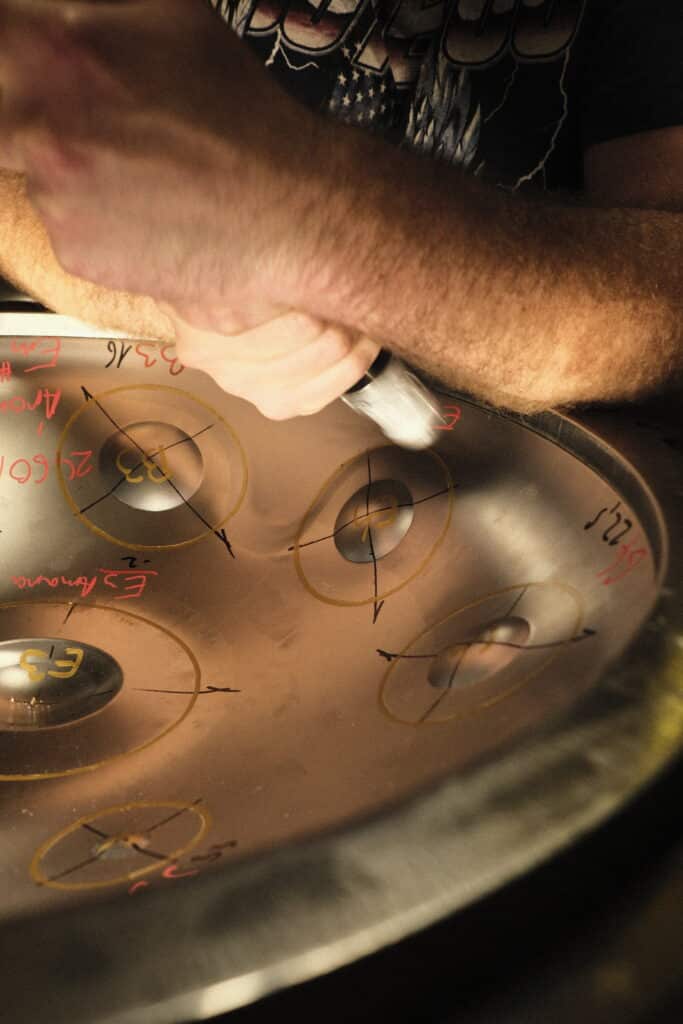
AISI 430 Stainless Steel
AISI 439 Stainless Steel
AISI 441 Stainless Steel
The manufacturing process begins with shaping, which determines the depth of the draw, the size of the tone fields, and the dimples.
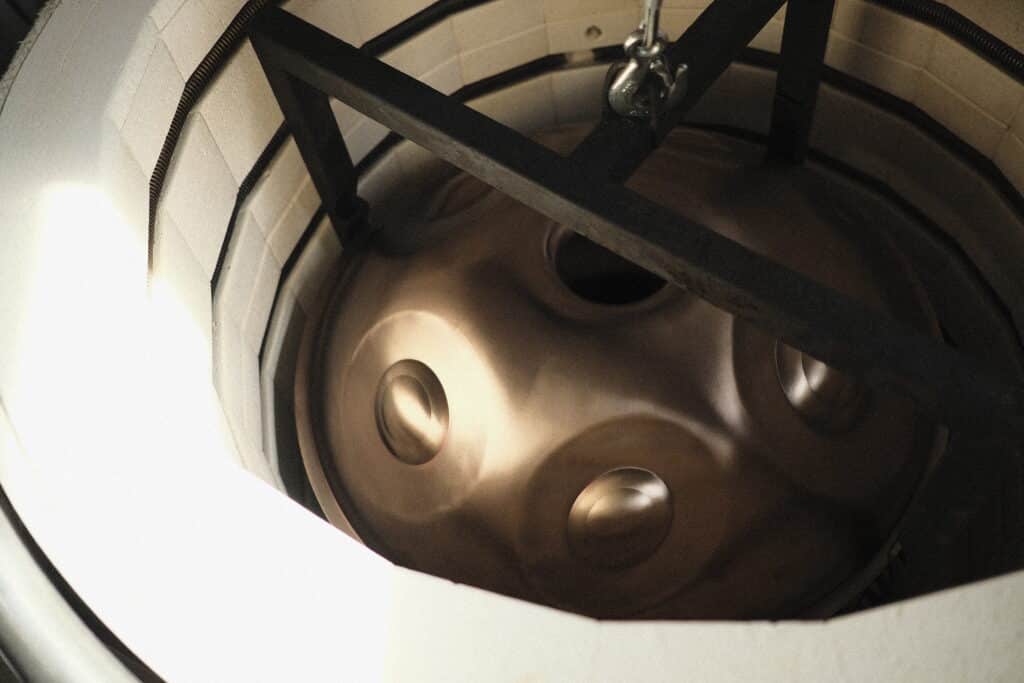
The shaped shell is then placed in a furnace for annealing (stress-relief heating) in order to stabilize and harden the material.
The heating temperature is critical. While nitrided steel is typically treated at around 400 °C, Ember Steel performs best at temperatures between 550 °C and 650 °C, where the metal begins to glow inside the furnace.
The workability of finished handpan shells can vary slightly depending on the material. For example, Ember Steel usually requires a bit more effort during the crafting process.
In the past, metal sheets were mostly shaped by hand using hammers, and instruments were created through traditional hand-forming techniques.
Today, however, shell manufacturers usually rely on precision pneumatic presses specifically designed for this purpose, which provide much more consistent and reliable results.
If you are interested in the handpans we create at MAG Instruments, browse them here:
To make sure we’re displaying the right prices for our instruments, please confirm your location.
