


If you’ve spent more than five minutes researching handpans, you probably encountered the D Kurd handpan scale.
It’s the scale beginners are pointed toward most often, the one that dominates YouTube performances, and the one nearly every handpan school uses for group classes. The question is: why?
This article covers everything you need to know, where the name comes from, what the notes are, what D Kurd actually sounds like, and whether it’s the right choice for you.

The name has two parts. The D refers to the root note, the lowest, central note of the instrument (called the Ding). The Kurd comes from the Arabic-Turkish Maqam Kurd, a traditional scale system found in classical Middle Eastern music, where “maqam” is roughly equivalent to our concept of a scale.
Victor Levinson of SPB Instruments, one of the earliest handpan makers outside of PANArt, was among the first to use the name “Kurd” to describe this specific arrangement of D minor notes on a handpan. The scale spread quickly and became the de facto standard of the instrument.
One thing worth knowing: D Kurd and D Minor are the same scale. If you see “D Minor” on a listing from a mass retailer, it’s almost certainly a D Kurd.
The handpan community uses “D Kurd.” Budget brands sometimes use “D Minor.” Same notes, same instrument.
The D Kurd is a fully diatonic natural minor scale, it contains all seven notes of D minor with nothing missing:
D – E – F – G – A – Bb – C
On a standard 9-note handpan, this looks like:
At MAG, D Kurd handpans are available from 11 to 17 notes. Adding notes extends the range, typically with additional octaves and lower bass notes while the core scale remains the same. The MAG D Kurd tongue drum has 11 notes, covering the same D minor foundation in a more compact, accessible format.
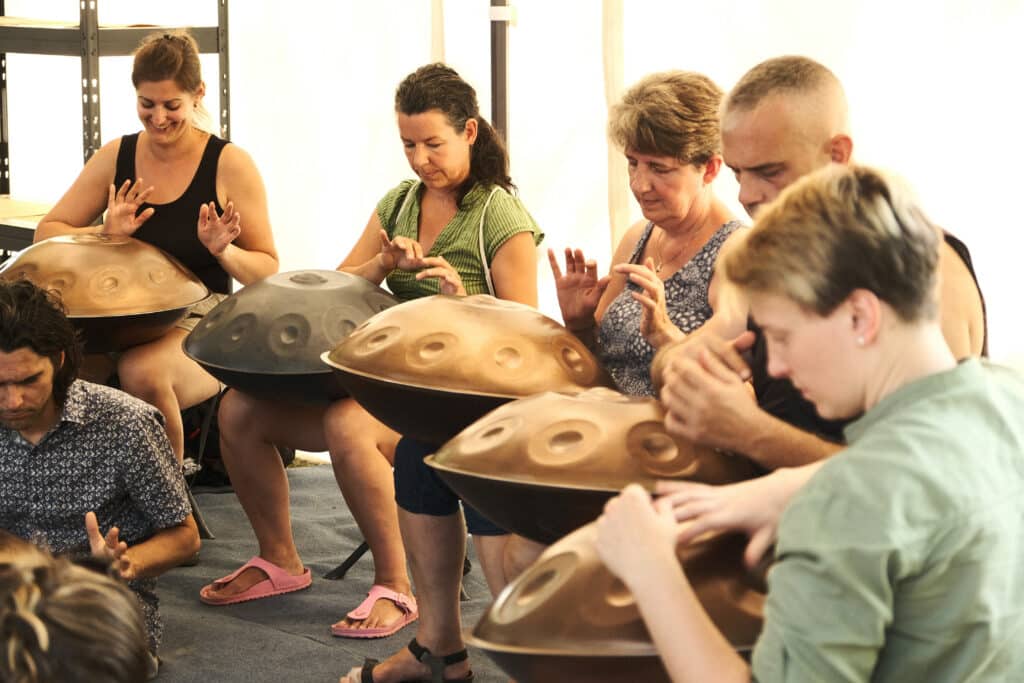
The D Kurd is often described as melancholic and soulful, but that’s only part of the picture.
What makes D Kurd genuinely versatile is that it contains both minor and major chords. The D minor, A minor, and C major chords all sit naturally within the scale. So depending on how you play it, D Kurd can sound introspective and meditative, warm and folk-like, or even bright and uplifting.
Played slowly, emphasising the D, F, and A, it sounds deeply meditative. This is why D Kurd is so common in sound therapy, yoga sessions, and sound baths.
Played rhythmically, with the Bb brought forward, it takes on a dramatic, almost cinematic quality, a sound that carries the slight tension characteristic of Phrygian and Arabic music traditions.
Played fast with percussive patterns, it becomes energetic and expressive, with enough harmonic range to move through contrasting moods within a single piece.
The note that gives D Kurd its distinctive edge is the Bb (B-flat). In a standard linear D minor scale, Bb sits at the sixth degree. On a handpan, because of the circular note layout, it appears much earlier in the playing sequence which makes it more prominent, adding a darker, slightly Middle Eastern feeling to the instrument’s natural voice.
Here is one of our D Kurd handpans as played by MAG Instruments co-founder, Peter Bognar:
The layout of D Kurd is genuinely logical. Adjacent notes are naturally harmonious, which means improvising freely rarely produces combinations that sound wrong. You can strike notes in almost any order and produce something musical. This matters enormously when you’re still finding your way around the instrument.
There are also practical reasons. More tutorials, courses, and YouTube demonstrations exist for D Kurd than for any other handpan scale combined. If you want to learn from online resources which most beginners do, D Kurd gives you the largest possible library to draw from.
Almost all handpan schools use D Kurd for group classes. The scale is approachable for complete beginners, but it has enough harmonic depth to stay interesting for experienced players. It’s a rare combination.
If you’re comparing D Kurd to other options, here’s where it stands:
The Celtic scale leaves the Bb note out, removing the semitone step that gives Kurd its tension. The result is more open and flowing, closer to a pentatonic feel. Beautiful for folk-inspired playing, but with less emotional range. This scale is also called D Amara.
Pygmy is a pentatonic minor scale with a more rhythmic, tribal character. It’s excellent for groove-based playing but offers fewer harmonic combinations than the full diatonic Kurd.
Same structure, different root note. F# Kurd is transposed a major third higher, giving it a slightly brighter quality. It works well alongside a D Kurd if you’re playing with other musicians.
The D Kurd scale sounds beautiful on both instruments, but the experience of playing each is different.
A handpan in D Kurd produces a warm, resonant, sustained tone that fills the room. The sound is produced by the entire steel shell vibrating, giving each note a layered character a fundamental tone plus harmonics that bloom and fade slowly. It’s more expressive, responds to subtle variations in touch, and rewards a more nuanced playing approach.
A tongue drum in D Kurd produces a crisper, more defined tone with a distinct metallic ring. The tongues (the cut sections of the steel surface) vibrate individually rather than the whole shell, giving each note a more immediate, percussive character. It’s lighter to transport, easier to play with mallets, and has a generally more accessible price point.
Both instruments carry the same D minor emotional character.
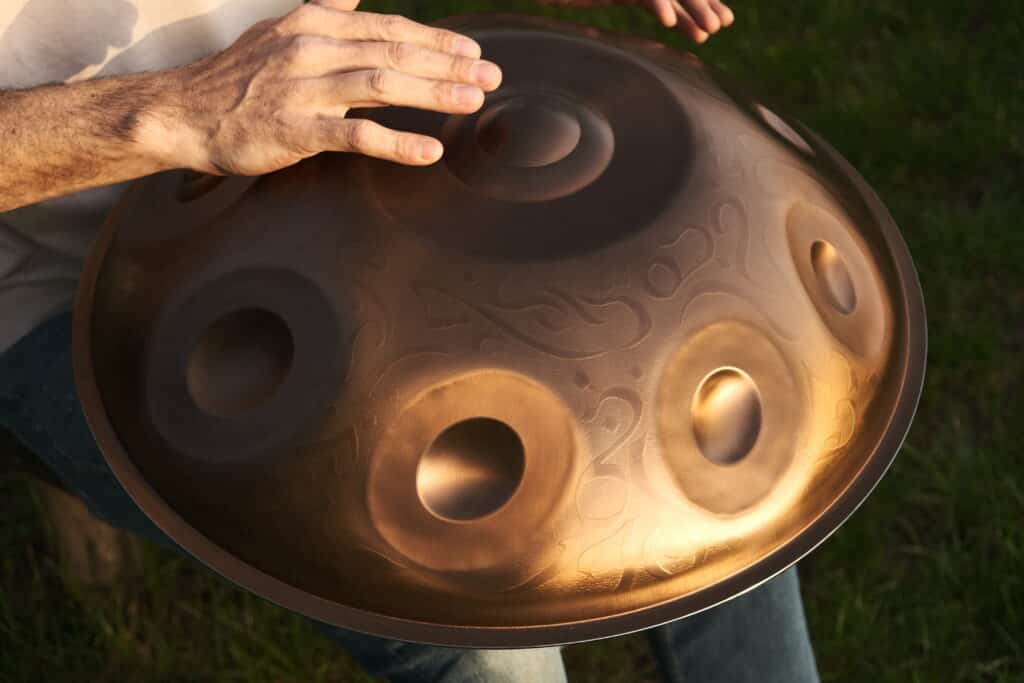
MAG produces D Kurd instruments in two forms:
The MAG D Kurd Handpan is available from 11 all the way up to 17 notes, hand-tuned by our master tuners in Győr and Budapest, Hungary. Every instrument comes with our Lifetime Retuning Warranty, if it ever goes out of tune, we will tune it back, free of charge, forever. Prices start at €2,000 depending on note count and configuration.
The MAG D Kurd Tongue Drum is an 11-note instrument sharing the same foundational scale, playable by hand or with mallets. It’s a compact, more accessible option for anyone drawn to the sound of D Kurd but not yet ready to invest in a full handpan, or simply looking for a complementary instrument. They are priced from €613.
Both are in stock and available to order directly from our webshop.
Not sure which scale is right for you? Read our overview: 10 handpan scales — which one is right for you?
New to handpans altogether? Start here: What is a handpan?
To make sure we’re displaying the right prices for our instruments, please confirm your location.
