


The steel tongue drum is one of the most beginner-friendly and versatile instruments you can own. Equally at home in a meditation session, a music therapy practice, or simply on your living room floor on a quiet evening.
Its bell-like tones are immediately soothing, it requires no musical training to start playing, and it comes in enough sizes, scales, and configurations that finding the right one can feel overwhelming without a proper guide.
We also included a practical guide to help choose the perfect tongue drum for you.
Despite its name, the tongue drum, lacking a membrane, is not actually a drum. It is a percussion idiophone instrument, meaning the sound is produced by the vibration of the instrument’s body itself, without the need for any other intermediary like strings.
The sound of a tongue drum is produced by the vibration of “tongues,” which are plates cut into the surface of the hollow body of the instrument. The instrument is played by striking these tongues with your hands or, more commonly, with mallets (aka. beaters).
The tongues can vary in size and shape, resulting in different sounds. A tongue drum can be tuned and is available in both wood and metal versions.
The instrument is extremely popular among musicians and hobbyists alike, due to its simplicity, diverse range of sounds, and versatility across various musical genres.
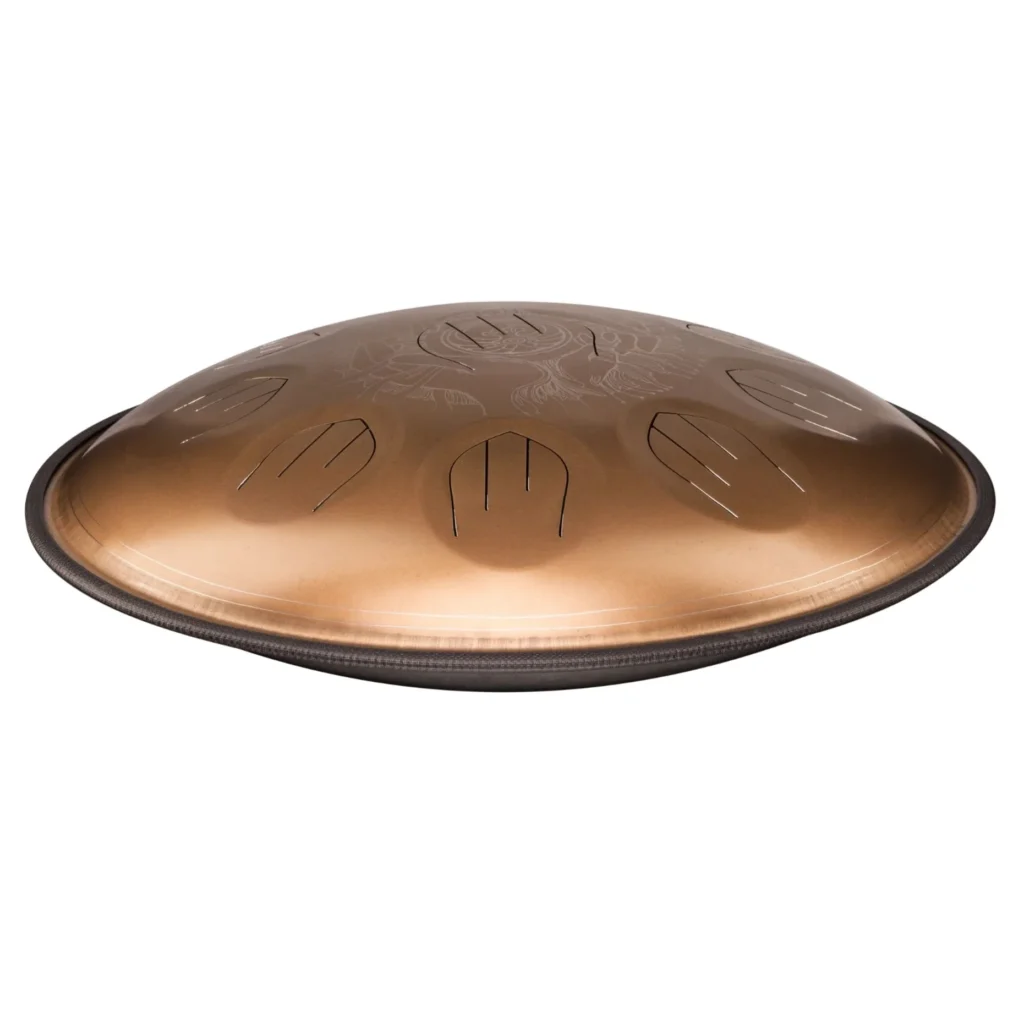
The ancient, simple forms of what we now know as the tongue drum were primarily crafted from materials like turtle shells or hollowed-out logs in Asia, Africa, and the Americas. These instruments, referred to as slit drums, laid the foundation for the modern metal tongue drum.
These early tongue drums hold significant cultural importance.
Traditionally, they were used in religious ceremonies, celebrations, and for communication.
In Africa, they accompanied storytelling, in North America, tribes used them in healing rituals, while in Asia, they were played during meditation and spiritual celebrations.
Nowadays, tongue drums are made from metals such as steel, aluminum, and other alloys.
These modern tongue drums are more durable than their predecessors and offer superior, clearer sound resonance. Thanks to advancements in tuning techniques, the instrument has become suitable for much more complex use.
Tongue drums can be classified into two types based on their material:
The first direct predecessor of the steel tongue drum, was crafted by Jim Doble and Felle Vega in the 1990s from a propane gas tank, which they named the Whale Drum. In 2007, instrument maker Dennis Havlena further developed this concept, drawing inspiration from the Hang® created in 2001. This led to the creation of the first steel tongue drum, called the Hank Drum (a blend of Hang® and tank).
Soon, other instrument makers followed suit, creating their versions of the hang drum, now commonly referred to as the steel tongue drum. Today, numerous companies around the world produce this type of instrument.
Historically, tongue drums have been used for spiritual and ritualistic purposes, often as part of tribal ceremonies, communication tools, or for religious aims, particularly within African and Asian cultures.
Today, the tongue drum has found its place in modern music. It can be played as a solo instrument or as part of an ensemble, frequently blended with other percussion and string instruments.
Tongue drums are commonly used in meditation, relaxation, and healing practices, as well as in sound baths and sound therapy. Its soothing tones make it a popular choice for yoga classes, spas, and therapeutic sessions.
The instrument also fits well within world music, ambient, jazz, and electronic genres.
Tongue drum sizes are typically given in diameter, and it’s common to see them measured in inches (symbol: “), so it’s helpful to be familiar with this before purchasing.
1 inch = 2.54 cm
Tongue drums vary significantly in size, with the smallest being about 3” (8 cm) and the largest exceeding 14” (35 cm).
Larger instruments produce deeper, more resonant sounds, making them more suitable for professionals. Smaller tongue drums have sharper sounds and are easier to handle, making them ideal for beginners.
The mini tongue drum and small tongue drum are compact versions of the steel tongue drum. The mini typically has a diameter of 6–8 inches (15–20 cm), though even smaller versions exist, around 3 inches (7–8 cm). The small tongue drum is slightly larger, with a diameter of 8–10 inches (20-25 cm).
One of the mini tongue drums is the so-called pocket tongue drum (referred to as mini S by some manufacturers and pocket by others), which is the smallest tongue drum with a diameter of just 3 inches. Its sound is high-pitched, sharp, and metallic. Its advantage lies in its portability—you can take it out and enjoy its soothing tones anytime, anywhere, without any prior musical training.
The small tongue drums are easy to transport, making them ideal for travel. They are also beginner-friendly, allowing anyone to quickly learn how to play enjoyable music.
The medium tongue drum, ranging from 10-12”, is less suitable for transportation.
Smaller tongue drums are excellent for use in yoga, meditation, and relaxation sessions, such as sound baths.
Listen to the sounds:
The large tongue drum has a diameter of 12-14”, while the giant tongue drum is even larger.
These sizable steel tongue drums require more advanced skills to play, and are not easily portable, whoever their much richer and more diverse sounds truly compensate for their proportions.
These drums are best suited for use in spacious environments like institutions or outdoors, thanks to their impressive, powerful sound.
Explore our premium MAG tongue drums:
The more tongues a drum has, the greater the musical variety it offers. With more notes, you can play a wider array of songs and explore more complex musical styles, although this also makes playing more challenging.
Fewer notes yield a more cohesive sound, which is especially suited for meditative music.
Tongue drums can have anywhere from 6 to 14 notes.
For beginners, tongue drums with fewer notes are recommended.
It’s important to note that manufacturers may count the number of notes differently. Some include the center note, known as the Ding, in the total, while others list it separately.
Therefore, notes can be listed in two ways: 7+1 or 8.
Make sure to clarify this with the manufacturer before purchasing!
The scale of a tongue drum is one of the most important decisions you’ll make when choosing one. It determines not just which notes you can play, but the entire emotional character of the instrument.
Tongue drums are tuned to specific modal scales, each with its own mood and personality. Unlike a piano or guitar, you can’t change key mid-song: the instrument is built around one scale, and that scale shapes every sound it makes. This is actually a feature, not a limitation, as it means every note you play is guaranteed to sound good with every other note on the instrument. You simply cannot play a wrong note.
The most useful way to think about scales isn’t in terms of music theory, it’s in terms of feeling.
Do you want something meditative and introspective? Warm and grounding? Bright and uplifting?
The MAG tongue drum range is available in six carefully chosen scales, each with a distinct character:
Tank Drum: Cylinder-shaped, minimalist, and simple; ideal for meditation and healing practices.
Groove Style drum: Features tongues recessed into the body of the drum, giving it a unique look and sound.
Hexagonal drum: Six-sided tongue drums with a distinct sound and appearance.
There are also other designs that vary in their aesthetics and may influence the sound and musical style of the instrument, with some being purely decorative and others affecting the instrument’s tonal qualities.

Larger drums: These produce deeper and more powerful sounds that last longer and fill larger spaces. Their lower frequency sounds are in the bass range, and they tend to be more expensive. They are recommended for advanced players and musicians.
Medium and smaller drums: These produce higher, sharper, and ringing tones. They are more affordable. The smallest sizes are suitable for children to learn on.
For beginners, it’s advisable to choose a smaller or medium-sized tongue drum because:
For children, the small and mini versions are recommended. These versions are also the most suitable for travel.
For practice, small and medium sizes are recommended because:
For solo playing, medium and small sizes are ideal:
For meditation and relaxation exercises, the medium size is the best choice.
Medium and large drums are well-suited for ensemble playing, as their sound stands out among other instruments.
Large drums are recommended for outdoor use and large rooms, as their sound carries over long distances and fills expansive spaces.
Handpan: Generally larger than the tongue drum, it offers a stronger and fuller sound. Its soothing tones are enchanting and deeply captivating.
Advantages of handpan:
Disadvantages of handpan:
Tongue drum: Made from thicker metal, its sound lasts longer and resonates better. It is known for its calming sound, though slightly less magical than the handpan.
Advantages of tongue drum:
Disadvantages of tongue drum:
Neither instrument is inherently better or worse; the ideal choice depends entirely on your personal needs and preferences.
If you’re a beginner and don’t want to spend too much, the tongue drum is an excellent choice, as you can purchase a beautifully sounding instrument at a more affordable price.
If you’re interested in playing an instrument with a wider range of tones and are willing to invest more, consider the handpan. You might start by renting one to avoid a large upfront cost. If you fall in love with it, you can always buy a second-hand instrument. And once you become more serious about them, you can explore the MAG handpan selection.
To make sure we’re displaying the right prices for our instruments, please confirm your location.
