


Following its invention, the handpan quickly became incredibly popular among musicians and began to be used in sound healing (sound therapy) due to its relaxing, enchanting sound and healing frequencies.
In this article, you’ll discover its therapeutic and relaxing effects and get tips on how to use the handpan for meditation and breathing exercises!
Sound healing is an ancient healing practice used by many cultures worldwide, which we are now rediscovering and applying once more.
Sound healing is based on the vibrations of sound waves, some of whose positive effects have been scientifically validated.
Typically, sound healing involves sound baths and sound therapy, which do not rely on melodic music.
Traditional instruments for sound healing include the Tibetan singing bowl, rainmaker, crystal harp, and gong, with the handpan also being a new addition.
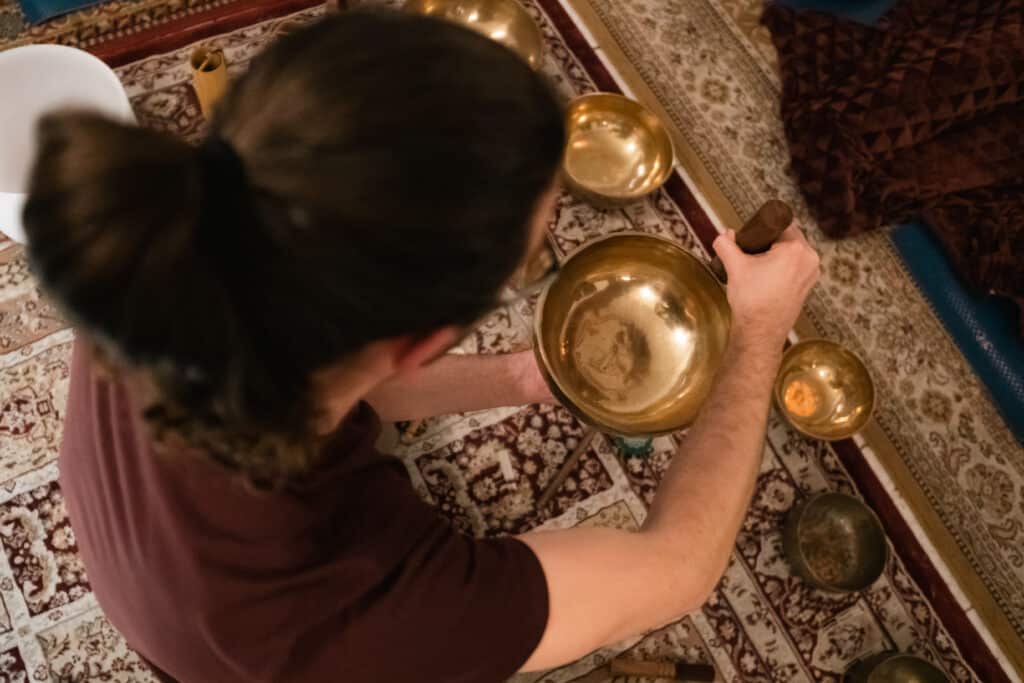
We have long known that music affects our emotions, for example, by calming us and aiding in sleep.
Sound is generated by air vibrations, which influence us on the neurological, psychological, and biochemical levels.
Research has shown that sound waves slow brainwaves and bring the entire body into a calm, sleep-like state.
A 2020 study confirmed that sound therapy significantly slows brainwaves, calming the brain, which in turn slows breathing and heart rate and lowers blood pressure.
The handpan is a remarkably unique instrument with versatile and distinctive properties.
Its uniqueness lies in it being a percussive instrument like drums, yet when struck, it produces rhythmic, yet catchy and melodic music. The sound comes from the vibrations of the instrument’s body, which spread out in all directions and fill the space.
The essence lies in the vibration—air vibrating at the right frequency and wavelength.
The handpan owes its delicate sound and vibrations to its design: it’s a lens-shaped instrument, essentially made by bonding two shallow steel half-shells, hollow on the inside. When you strike the handpan, the air inside the body resonates, creating sound; this vibration is known as Helmholtz resonance.
This serene, subtle vibration makes the handpan a perfect instrument for sound therapy and meditation.
According to many therapists, certain sound frequencies can reduce stress and improve mental and emotional well-being.
The handpan is thus the “super instrument” of sound therapy, resonating at a unique frequency rarely found in other instruments, except for the steel drum.
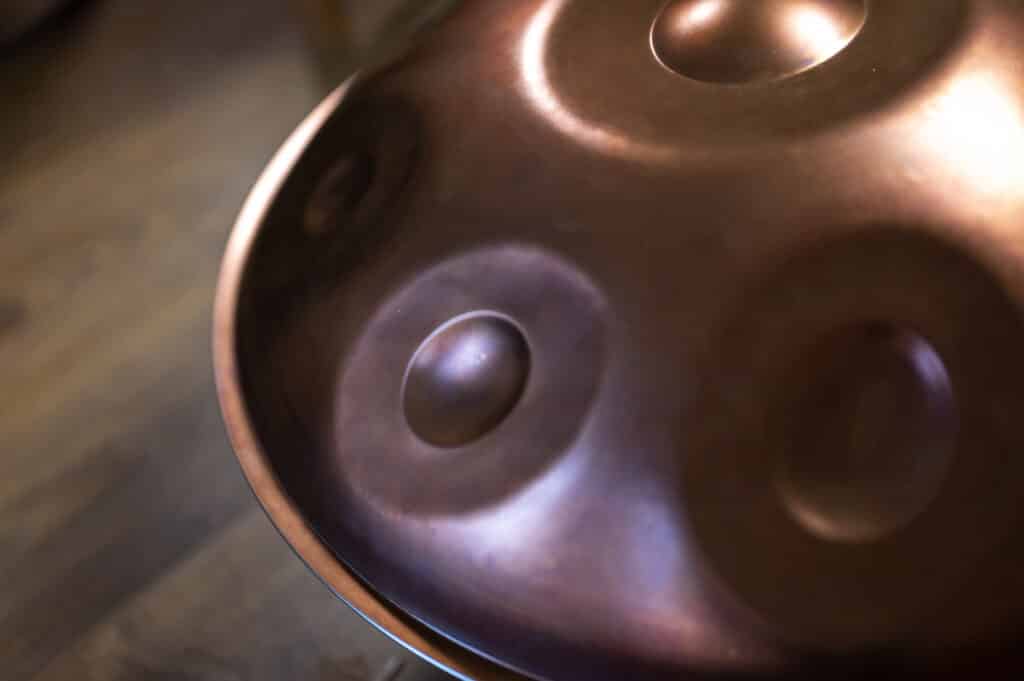
The handpan is among the few instruments with a tuning frequency ratio of 1:2:3. This means that every note encompasses three frequencies:
The octave’s frequency is half of the fundamental tone, and the compound fifth harmonic is a third.
This is significant because perception researchers have concluded that the human brain prefers to simplify frequency ratios. Since the handpan’s frequency ratio is as simple as possible, it is harmonious and soothing to our brains. The 3:2:1 frequency ratio sends a message to the brain that it’s safe to release stress and tension.
Besides the handpan, only steel drums have similar tuning.
Another reason the handpan is calming is a phenomenon in music education called “entrainment.” This occurs when two objects with different vibrations are placed next to each other—in this case, the handpan and the human body.
As a result, the handpan can energetically and physically support the release of stress and tension from the human body.
Physicists have told us that every living and non-living body in the world has its own vibration at a specific frequency.
Frequency refers to the rate at which sound waves repeat—essentially, the speed of vibration. The faster the cycles repeat, the higher the sound. Frequency is measured in Hertz (Hz), representing the number of cycles per second. In the case of music played on instruments, it is equivalent to the number of beats.
Examples of frequencies:
Therapists generally use specific frequencies for sound healing.
Currently, the standard tuning for instruments worldwide is A4 at 440 Hz. However, an alternative exists used in some sound healing and meditation circles: 432 Hz.
Healers believe that 432 Hz is more natural for promoting well-being and releasing emotional blockages.
The harmonious sound of the handpan quickly helps you find inner peace and rid yourself of the distracting thoughts of everyday life, allowing you to relax and recharge.
Whenever possible, listen to live handpan music during meditation, attend handpan concerts, or experience sound baths.
For daily meditation, listen to recorded handpan music designed for deep focus.
The handpan is one of the best instruments for playing relaxation music.
Unlike most instruments, you can intuitively play the handpan; its tuning ensures you can’t hit a wrong note, allowing you to learn simple melodies relatively easily and quickly. This ensures a constant sense of achievement without losing enthusiasm. 🙂
Playing the handpan is incredibly calming and meditative. It aids relaxation even during practice because focusing on proper playing helps prevent preoccupying yourself with stress-inducing thoughts.
Even as a beginner, you can effectively use the handpan for sound healing, as it helps divert your thoughts. Its softly resonating, enchanting sound helps you disconnect and get lost in the moment—not to mention the joy of playing music!
Of course, you’ll need practice and routine, so don’t expect the movements to come automatically right from the start. However, if you invest time and enjoy practicing, you’ll reach a level where you no longer need to think about the strikes, and everything “will just flow naturally”.
Playing the handpan and practicing breathing exercises can work incredibly effectively together as meditation techniques.
Handpan playing requires deep, mindful breathing, allowing the mind and body to relax.
Moreover, breathing influences music playing, and vice versa.
You can use handpan playing as a tool for breathing exercises.
For example, inhale during intense playing and exhale as the intensity subsides.
This exercise can help you regulate your breathing, achieve a relaxed state, and relieve stress.
Focusing on your breathing and handpan playing prevents you from dwelling on problems, keeping disruptive thoughts at bay, allowing inner peace to flow through you, calming your mind, and instilling tranquility in your soul.
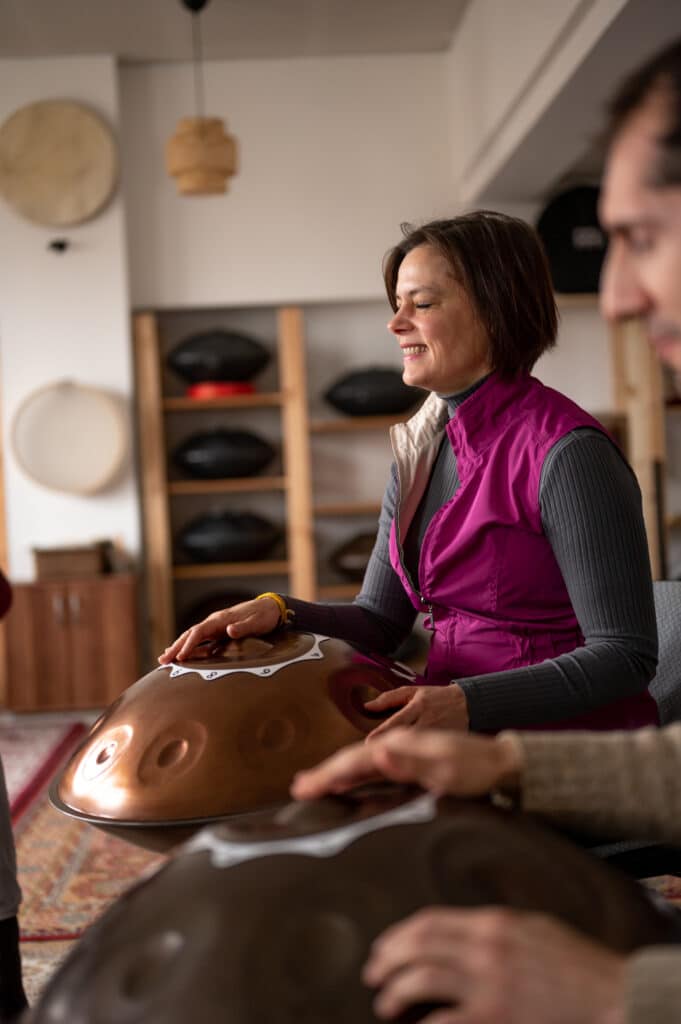
It’s not just the instrument but the rhythm of the music that matters when you want to meditate, delve deep, and slow down. Naturally, slower-paced music is ideal for relaxation.
Music rhythm is measured in beats per minute (bpm).
The human heart, for example, beats at around 60–80 bpm.
The ideal rhythm for relaxation is approximately 44 bpm, suitable for breathing exercises, sound healing, meditation, gentle yoga, and yoga nidra.
Therefore, the handpan is the perfect instrument for listening to relaxation music. It’s excellent for sound healing, and since it is a highly intuitive instrument, you can relatively quickly learn the basics.
All you need is a handpan with a crystal-clear sound that delights your ears and heart. Browse our webshop to find your favorite scale!
To make sure we’re displaying the right prices for our instruments, please confirm your location.
