


Fundamental polyrhythm exercises for handpan players and general music learners to help make your playing more dynamic.
We’ve collected a few practical examples and video tutorials to help you enhance your rhythmic skills.
In Western music, rhythms are usually well-defined and straightforward, such as 4/4, 6/8, etc. These denote the number of beats.
In contrast, polyrhythms lack this regularity.
Polyrhythm, or cross-rhythm, refers to the simultaneous use of different rhythms or time signatures in polyphonic music, combining various rhythmic patterns.
The essence of polyrhythm is that a musical piece does not follow a uniform rhythm.
Imagine it as several different rhythms layered on top of each other track by track.
It can also be described as the absence of minimum note length within a measure. For example, a musical passage isn’t restricted to having at least eight or sixteen notes—there’s no set lower limit on note length.
Polyrhythms are typical in dance music and jazz but also appear in classical and folk music. They are a distinctive feature of African and Indian music’s unique soundscape.
Polyrhythm enriches music, making it energetic and exciting, while also introducing unpredictability and uncertainty.
Music with polyrhythms often features more sophisticated rhythms, is more complex, and is great for dancing!

Try tapping one beat with your left hand and two with your right at a table (say, at a family dinner). Ask your family to try as well. Most people, especially without musical experience, can’t do it at first.
A polyrhythm is a rhythmic pattern where two or more different rhythms occur simultaneously.
On a handpan, this typically means one hand plays a certain beat (e.g., a 3-beat pulse), while the other plays a different pulse (e.g., a 4-beat or 5-beat pulse).
Polyrhythms are often used to create grooves and complex rhythmic patterns, making playing more exciting and dynamic.
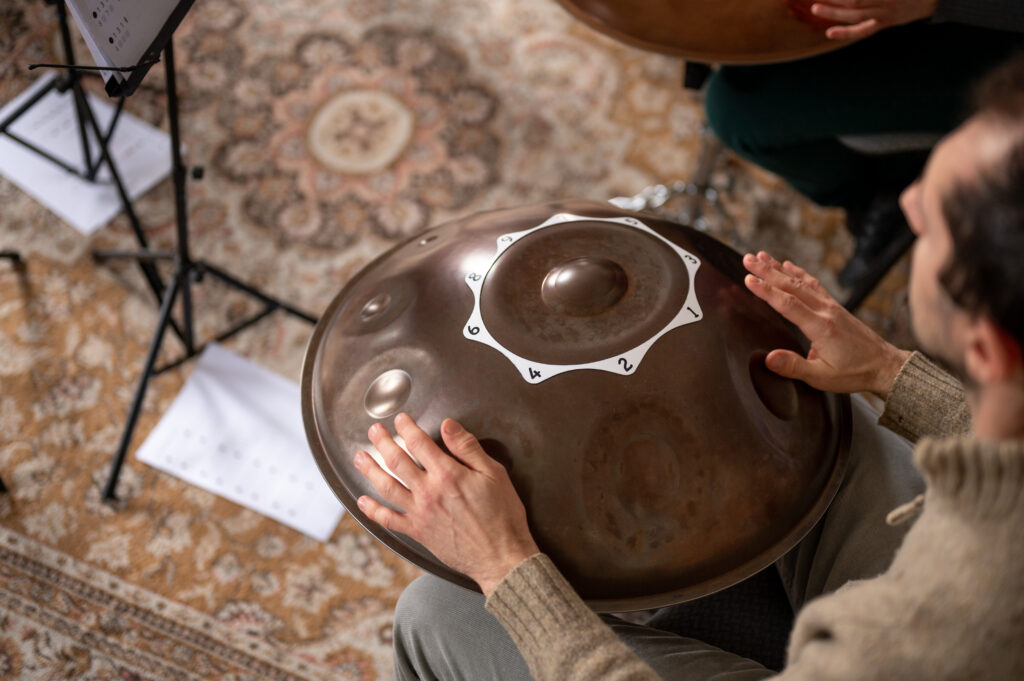
While polyrhythms aren’t among the easiest techniques, there are relatively easy-to-learn polyrhythms for beginners and more advanced ones for seasoned players.
Beginners: Start with the simplest polyrhythms, such as the 3:2 ratio, where one hand plays three beats while the other plays two in the same time frame.
Intermediate: Try more complex combinations like the 4:3 or 5:2 rhythms.
Advanced: Explore complex, multi-layered polyrhythms with alternating accents and variations.
Polyrhythms require precise hand coordination and a stable base rhythm. One hand plays a simple groove while the other follows a different rhythmic pattern.
Polyrhythm techniques and beats:
Different rhythms are played by the hands with unequal energy. There is always a dominant hand (usually the right hand for right-handed players) that typically plays the steadier or primary pulse.
The other hand complements with an alternative rhythm.
Which rhythm becomes dominant depends on the instrument.
Base rhythm: Start with a stable base rhythm, such as a simple 4/4 measure or a basic groove.
Overlay rhythm: Layer another rhythm or time signature over the base rhythm. It can be a 3:4 or a 7:8 groove or anything that creates contrast with the base rhythm.
Syncopation and bending: Experiment with syncopation and bending to seamlessly integrate the overlay rhythm into the base rhythm. This adds complexity and makes the polyrhythms more exciting.
Practice, practice, practice: Polyrhythms require precise coordination, so don’t be discouraged if it takes time to master them. Practice each rhythm separately, then gradually start playing them together until you can smoothly blend them.
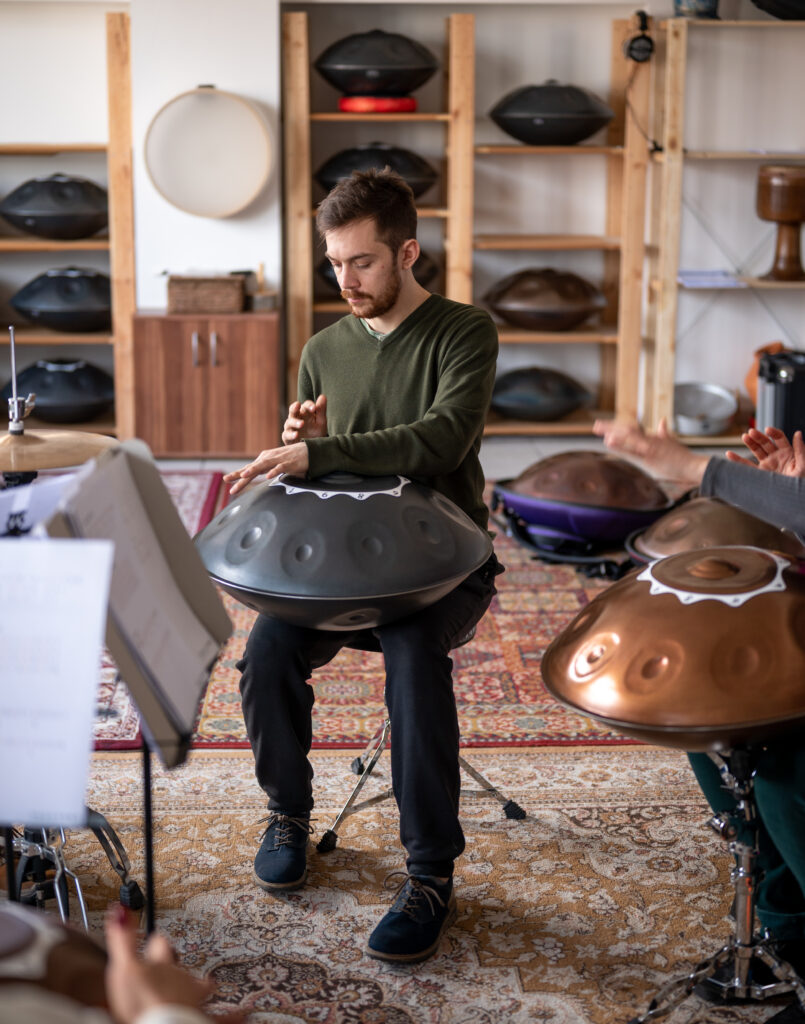
Start by practicing simpler polyrhythmic patterns, such as 3:2, 3:4, or 5:7 rhythms. This will develop your sense of the interaction between different rhythms.
If you’re visual, the following simple table can help you understand how to start playing the 3:2 base rhythm:
R = right hand, L = left hand, numbers represent the beat count
| 1 | 2 | 3 | 4 | 5 | 6 |
| J | J | J | |||
| B | B |
Here’s another illustration to demonstrate why the spacing between strikes is unequal:
From the following video clip, you’ll understand even more easily:
Using the following English video, you can also learn the basic 3:2 polyrhythm:
The same logic applies to the 3:4 polyrhythm:
And now try one of the most famous polyrithms, a simple but satisfying tune with a memorable name:
As you become more confident, gradually increase the complexity of your polyrhythmic patterns.
Experiment with different combinations and variations to expand your rhythmic repertoire.
Experiment with playing polyrhythms at different tempos to discover how changes in tempo affect the mood of the music.
Try live looping and layer polyrhythms in real-time to create magical and intricate compositions in moments.
The metronome is the best tool to practice rhythm and timing, regardless of which instrument you play.
You can download metronome apps from various app stores for free. You can set the beats per minute (BPM) on them, which provides the base rhythm for practice. Start slow initially, for example, at 60 BPM, meaning the metronome ticks once per second.
If you find it challenging to play polyrhythms immediately with a simple metronome, try using a polyrhythm metronome, like the PolyNome app, or search in app stores. This plays every beat from both time signatures you set, helping you synchronize and improve your practice.
To make sure we’re displaying the right prices for our instruments, please confirm your location.
