


Handpan composition and songwriting basics for beginner composers and tips for advanced musicians. Learn musical structures and motifs and start writing your first song today. Below, we provide a practical guide primarily for instrumental songwriting.
Songwriting and composition can be both spontaneous and deliberate, but if you’ve never tried it before, it’s worth learning the basics! Songwriting is a learnable process.
Anyone can become a creative composer, including you. If you don’t yet feel confident, rest assured, because creativity can be developed!
Moreover, the handpan is one of the best instruments for practice, as it is highly intuitive, and you can’t play a wrong note or melody. Beautiful sequences seem to come naturally.
By learning the basics of crafting catchy melodies, you’ll find songwriting much easier.
If you’ve invested in at least a mid-range handpan, you’ll likely be able to create melodies pleasing to the ear on your first try, even if you’ve never improvised before.
Handpan composition is a rewarding activity that will help you get the hang of songwriting and composition.
There is no single, universally accepted method for songwriting. It’s a bit like cooking: there are many ways to achieve a great result.
Composition is a learnable process, and there are numerous useful methods that can help you, whether you’re a beginner or an advanced musician.
It’s important to have a basic understanding of music theory and concepts like chords, melodies, harmony, and rhythm, which will greatly aid in writing your first song.
Songs can have a wide range of styles, genres, and structures. They can be regular or irregular, with rhyming or free lyrics.
The advantage of traditional songs is that they come with common melodic arrangements, predictable forms and sections, and at least one vocal melody, making things easier for beginners.
Traditional songwriting is straightforward because it falls within a musical range familiar to most people.
Most popular songs contain some combination of the following elements:
This structure applies mainly to songs with vocals. Even if you are writing instrumental music, understanding song structure is beneficial, as music within these sections can vary in chords, rhythm, energy, and mood.
Naturally, not every element listed must appear in every song, and some can be repeated multiple times.
As a beginner, it’s best to concentrate on the verse and chorus elements and consider adding a bridge to connect the two.
Another important aspect of song structure is the melodic arc.
Catchy melodies typically flow in a stepwise motion (ascending or descending by a half or whole step) with occasional leaps (moving up or down by any larger interval).
If musicians played randomly, the result would be displeasing to our ears.
We will discuss different melodic arcs in detail in a later section.
Initially, don’t worry too much about the specific parts of a song. Start by creating a foundation on which you can build your song and add elements later.
Here’s how to get started, as this is often the most challenging part:
Begin composing by playing chords. Gather a few chords that sound pleasing to your ear. Compile as many as you like.
Start playing them, experiment as much as possible, and connect them.
Play different chord combinations in various rhythms and styles.
You can also play chords in different pitches.
If you find chord combinations that you like, make a note of them.
Once you have your basic chord combinations, these will form the basis of your song.
However, remember that some of the most famous songs in popular music feature simple, repetitive chord combinations.
Think in simple musical units initially.
Songs are built from sections that together form a song’s structure.
Sections are musically cohesive units, such as the chorus, intro, or instrumental solos (in songs with vocals).
Most traditional songs use some variation of verse-chorus-verse-chorus structure.
After selecting a chord progression to work with, start extending and developing this material into other parts. You’ll need at least two distinct sections to construct verses and choruses.
Many songs use the same chords for the chorus and verse, but if you want the musical sections to stand out from each other, use different chords.
Therefore, it’s advisable to create a sharp contrast between the chorus and the verse.
Adding intros, instrumental sections, bridges, and conclusions is up to you, but beginners might want to wait before tackling these. If you decide to include such sections, add them to the song after assembling the chords. For example, you might add a transition section (bridge) between the verse and chorus as a beginner.
Once you feel you’ve laid the groundwork for your new song, make a recording and jot it down.
This is known as a demo and serves as a reference for you. Thus, your initial recording doesn’t need to be professional or polished. The goal here is to capture your new song so you can listen back to it later.
Start playing, practicing, and refining it.
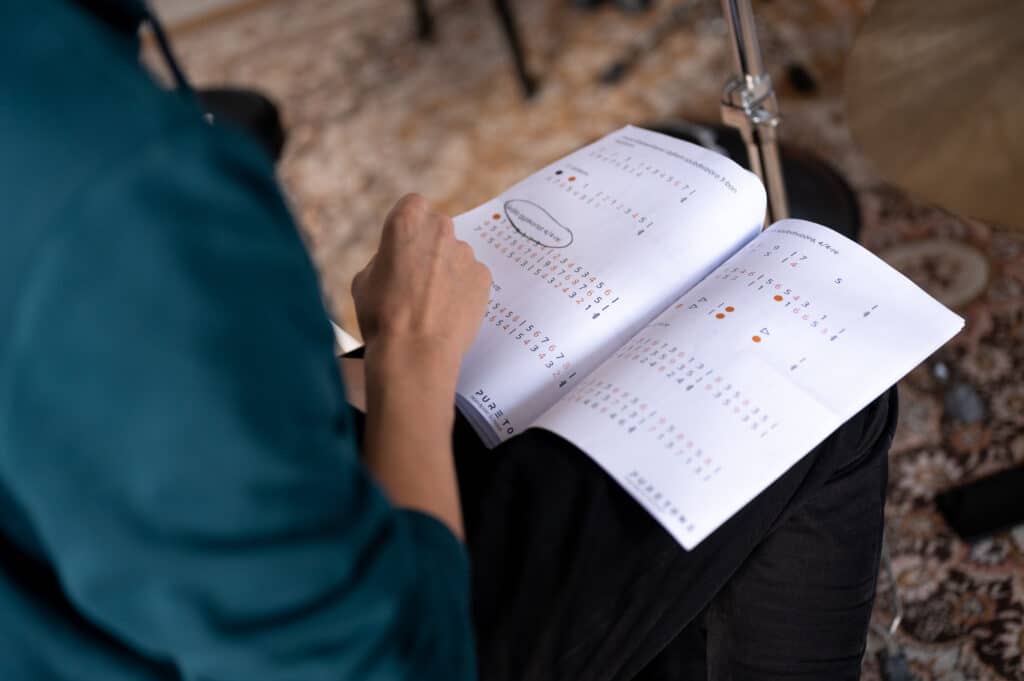
Note down any changes, whether by creating your own handpan notation or using traditional sheet music—choose whichever method is comfortable and easy for you to read later.
Tip for handpan notation: We’ve created our own notation system, where music is transcribed using codes assigned to the handpan notes (e.g., F=1, G=2, etc.). This makes reading back much simpler than with traditional sheet music.
When composing, you can build your song on a basic rhythm/groove and chords.
Then, add a melody, which you can improvise during play.
You can construct your first song using the following 7 combinations:
Find a basic rhythm or groove and a few chords that you like.
Play the groove.
Instead of starting with the Ding, choose one of the chords for the beat, and then play it together.
After each chord, return to the beat, then add a second chord in the next round.
It could look like this:
beat one – chord 1 – beat one – chord 2
Once you’ve played this a few times, add more chords and start combining them as you like.
If you like a combination, note it down and record it.
Once you’ve practiced the combinations, start embellishing them, eventually leading to a melody.
Add notes to the chords that appeal to you while playing, coloring them and creating new melodies.
Don’t overthink it, just follow your ear, as the handpan easily produces harmonious, catchy songs.
ust play, practice, experiment, and if you hit a combination that you like, record it, then repeat and fine-tune. Finally, add dynamics, and your first song is complete!
There are several methods to begin songwriting on the handpan. Here are a few examples:
1. Groove / rhythm
2. Melody
3. Bassline
4 .Chords
In this article, we will explore the first method in detail.
Before you continue reading, study the diagram below to ensure you understand the explanations. Knowing the parts of the handpan is essential for this.
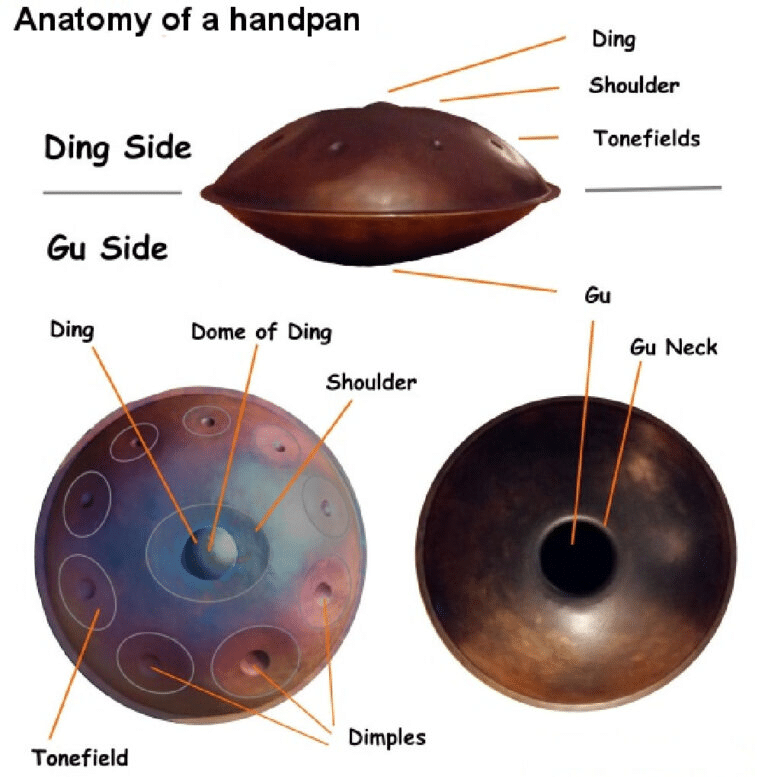
First, you’ll need a simple rhythm or groove. Anything you like works.
Let’s take the following as an example:
1+2+3+4
D……..T……
D=Ding, T=Tonefield
Alternate playing with your left and right hand on the Ding and the tone fields.
Always start with the Ding.
Alternate striking the Ding and a nearby Dimple. Play this a few times. You can strike the Dimple and Tonefield consecutively or alternate after each Ding.
Written out, it looks like this:
Basic combination: Ding – Dimple 1 (repeat several times)
Keep an eye on the rhythm!
Strike the Ding on every first beat and the Shoulder on every second beat for more variation. Insert your chosen Dimple between the two strikes.
Combination:
Ding – Dimple 1 – Shoulder – Dimple 1
Ding – Dimple 1 – Shoulder – Tonefield 1
Once you’ve played these combinations several times, you can gradually add more notes.
Ding – Dimple 1 – Shoulder – Dimple 2 –
Ding – Tonefield 1 – Shoulder- Tonefield 2
You can mix up the order as you like, for example, by striking the Tonefield of the same note directly after the Dimple:
Ding – Dimple 1 – Shoulder -Tonefield 1
Ding – Dimple 2 – Shoulder – Tonefield 2
In addition to the Ding and Shoulder, you can also strike the body of the handpan as an extra sound.
This way, your hand playing the Ding will strike the handpan three times:
Ding – Shoulder – Instrument body
Between these three strikes, use your other hand to play Dimple and Tonefield notes in any order you like.
As you progress with the piece, you can continuously add more notes.
Combination:
Ding – Dimple 1 – Tonefield 1
Shoulder – Dimple 2 – Tonefield 2
Instrument body – Dimple 3 – Tonefield 3
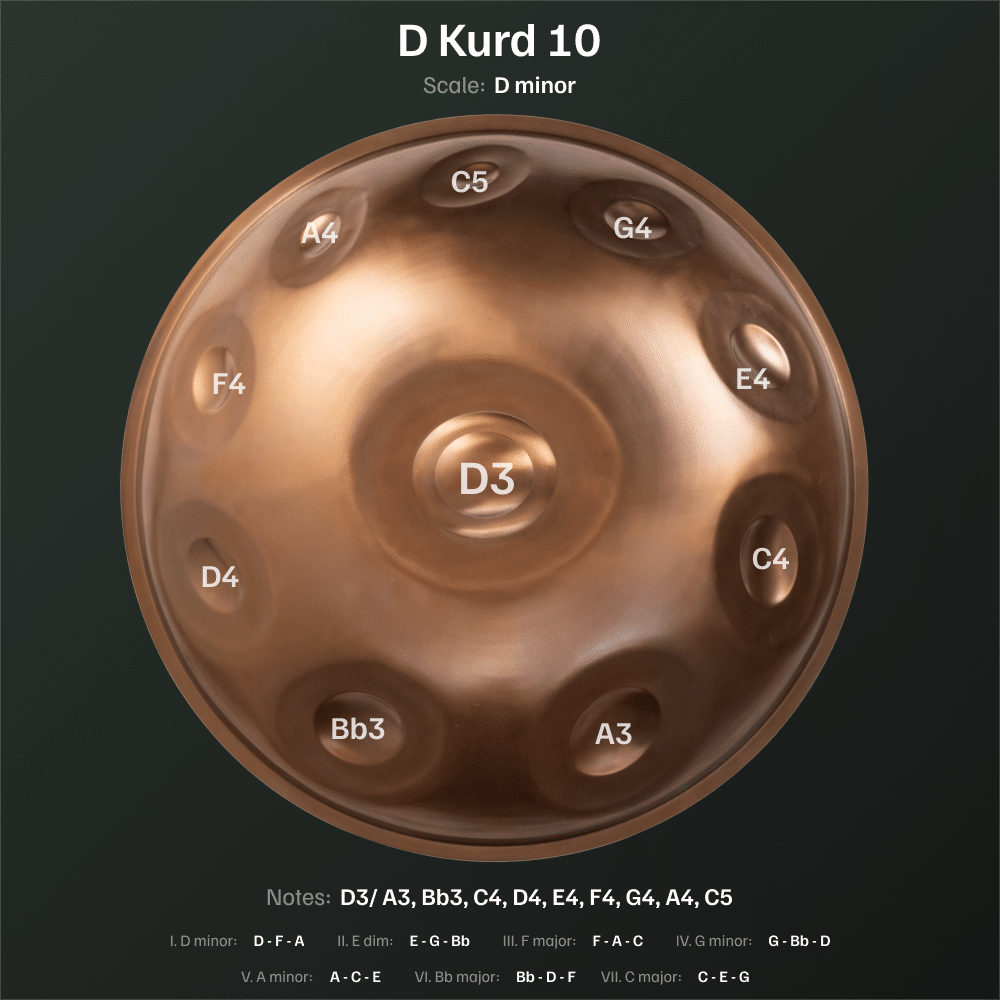
Let’s look at an example of the melody above on a specific handpan.
We’ve chosen the D Kurd scale because it’s a fundamental handpan scale, ideal for both beginners and professionals.
Combination:
Ding – D4 Dimple – D4 Tonefield
Shoulder -F4 Dimple – F4 Tonefield
Instrument body – A4 Dimple – A4 Tonefield
It’s important to follow a specific direction when transitioning between notes, rather than moving randomly.
This direction forms the melody’s arc, and it makes a melody catchy and memorable, encouraging you and your audience to listen repeatedly.
Here are some melodic arcs to start with:
Ascending-descending:
Start with a low note, reach a peak, and then let the melody descend.
The melody arc: low > high – peak > low
Continuously ascending:
The melody can move in a circular motion through the notes in one direction.
Alternating high and low:
You can alternate between high and low notes consecutively (high note – low note), allowing the melody to rise and fall.
You can use composition software, but don’t rely too heavily on these programs when you’re first creating music. For new composers, there’s a risk that depending too much on pre-written chord progressions might inhibit independent musical development.
Once you’re familiar with your instrument and confident in your playing, composing music can be the next step—and it’s a learnable process.
The handpan is an intuitive instrument, meaning that after mastering the basics of songwriting, you can also compose music on it.
Due to its unique sound palette and intuitive playing style, the handpan is an ideal companion for composition: it removes the fear of making mistakes, encouraging experimentation, playfulness, and self-expression.
Creativity can be developed—each strike brings you closer to your inner world.
If you’ve ever wanted to write music, the handpan is the ideal instrument for it.
To make sure we’re displaying the right prices for our instruments, please confirm your location.
