


8-note handpan vs. 17-note handpan: what’s the difference? which is recommended for whom? In this article, you’ll learn how the number of notes affects handpan selection for beginners, intermediates, and experienced musicians alike.
Handpan scales are known as partial musical scales, which means they do not contain all 7 diatonic notes (C, D, E, F, G, A, B). Instead, only a subset of notes from the designated scales are present. Additionally, handpan scales are not chromatic, meaning that the intervals between notes are more than a half step.
Therefore, whether you have an 8-note handpan or a 12-note handpan, the notes are not arranged sequentially. Let’s look at an example of a handpan we’ve crafted:
B Amara – B minor scale / 9 note handpan
The full B minor scale notes are: B, C♯, D, E, F♯, G and A.
The notes on the 9-note handpan / B minor scale are: B2/ F#3, A3, B3, C#4, D4, E4, F#4 és A4
The difference between B and B2 is merely pitch; however, you’ll notice that on the handpan scale, they don’t align: B2 is in the second octave, while C#4 is in the fourth. Hence, this handpan features five notes from the B minor scale with G missing, the starting B in a different octave, and an additional three notes not found in the scale.
New to handpans altogether? Start with the basics:
Handpans feature minor, major, and mixed scales, each with its own distinct sound and mood:
Manufacturers often name handpans based on the mood and musical scale, using creative names.
For example, “D Aegean” suggests a dreamlike, oceanic ambiance, while indicating the handpan is tuned to a D scale.
Want to explore how different scales sound and feel? Read our full overview: 10 handpan scales — which one is right for you?
When selecting a handpan, the scale and number of notes are crucial considerations, as they determine the best fit for your goals, taste, and skill level.
The number of notes affects:
Handpan notes are generally counted as follows: there is a central raised part (the Ding), which is the main/starting note.
Surrounding it are the scale notes (tone fields). Some manufacturers include the Ding in the total note count, while others denote it separately, e.g., 7+1 = 8-note handpan.
The fewest notes range from 7-8 (1 Ding + 6-7 tone fields), to as many as 30. A note count of 30 is considered extreme.
Smaller note counts were typical for classical, early models (e.g., the first generation Hang created by PANart of Switzerland), but over time, makers have added more and more notes to handpans.
Nowadays, 17-note handpans are quite common.
At MAG Instruments, we often craft handpans with 17-19 tone fields. One exception is the previously mentioned 9-note handpan with a B Amara scale.
The world record for the most tone fields on a handpan belongs to the 32 – note Mutant Monster, crafted by Satya Sound Sculptures in 2023.
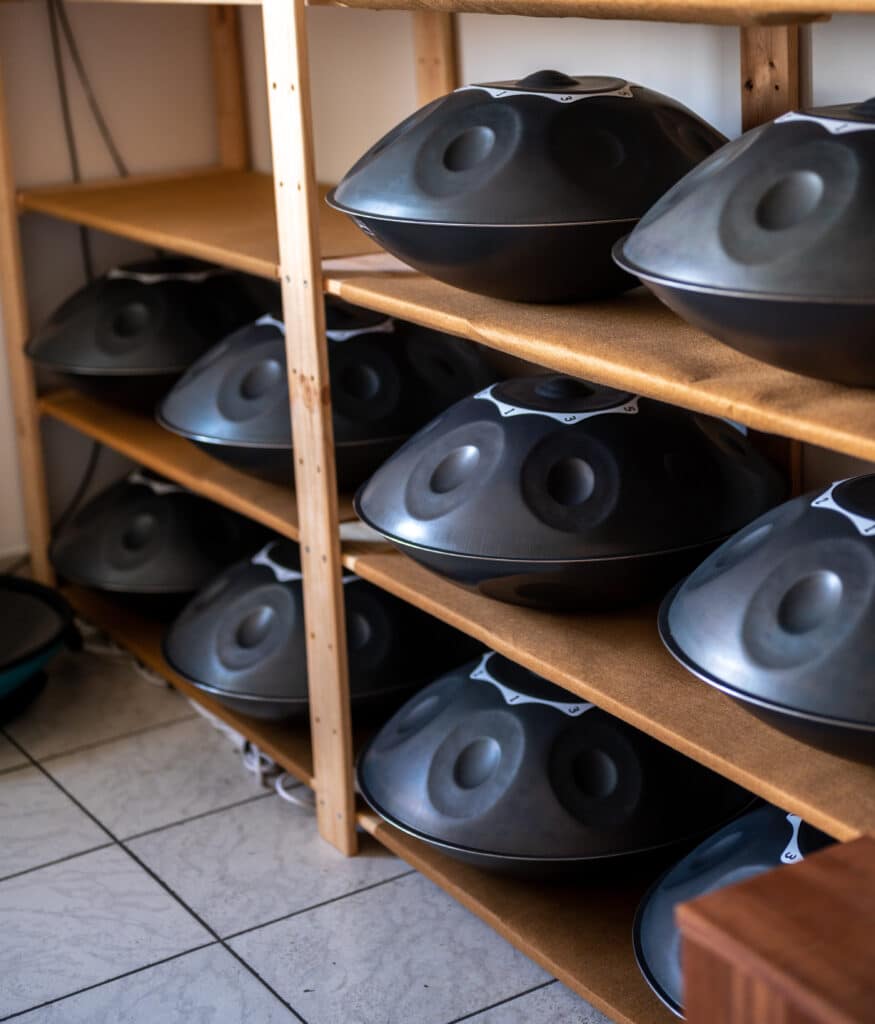
For beginners, 8-10 note handpans (Ding + 7-9 tone fields) are typically recommended, and this note count is currently standard across many manufacturers.
This range is also perfectly suitable for musicians.
The arrangement of tone fields on 8, 9, and 10 note handpans is classic and relatively straightforward.
If you’re just starting out with playing the handpan, a 9-note handpan is ideal because:
A 10-note handpan is slightly more complex, featuring more higher tones compared to a 7-8 note handpan.
It has the advantage that all notes are positioned on the top side, making them easy to reach.
Its range is broader and more varied than the typical note count of handpans but remains easy to handle, even for beginners. It offers greater creative potential without overwhelming the player.
The 10-note handpan is ideal for beginners looking to elevate their skills, as well as intermediate players seeking to expand their musical creativity.
Not sure what to look for as a beginner? Read: What makes a good beginner handpan: 9 key factors

Browse MAG’s entry-level and mid-range configurations — hand-tuned, Ember Steel, with a Lifetime Retuning Warranty included.
In the range of 11-15 note handpans, you may find chromatic scales, depending on the specific scale.
Some handpans might feature two Dings, while others have smaller high notes in the center. There are also handpans where the Ding is not placed centrally to allow additional high notes between the tone field edges and the Ding.
These handpans offer many variations compared to the typical 8-10 note handpans, depending on manufacturers or buyer preferences.
Consequently, 11-15 note handpans are far more complex than 8/9/10 note handpans.
Typically, two additional high notes are added to a 12-note handpan, expanding the musical possibilities.
All the notes are located on the top side of the handpan, so the playing style remains similar to that of a 10-note handpan.
It enables more complex and detailed music playing, broadens your musical repertoire, and offers more opportunities for creativity and improvisation.
However, a 12-note handpan demands more practice and comes at a higher price.
It is recommended for intermediate and advanced handpan players or beginners with a musical background.
“Extended Scales” and “Mutant” handpans have recently become extremely popular thanks to their diverse sounds and broader range.
video
Extended Scales handpans, or handpans with additional notes, are those containing more notes than the standard 8-10/12.
There are several ways to place extra notes:
Mutant handpans are special versions of extended scale handpans with unique musical profiles and atypical note arrangements.
The additional notes are located on the bottom of the instrument body.
Note placement varies from model to model. They may be arranged circularly around the tone fields, irregularly, and note sizes and shapes can differ significantly.
Playing Mutant handpans poses a greater challenge due to their complexity and non-sequential note placement.
Thus, Mutant handpans are recommended for experienced and professional musicians.
In our opinion, handpans with at least 12 notes are fantastic instruments, but for the sake of objectivity, we should also mention some potential drawbacks:
Nonetheless, extended scale handpans with at least 12 notes are becoming increasingly popular, especially among professional musicians. A 17-note handpan, for example, offers significantly more musical possibilities. The broader range of playable songs requires creativity and provides an incredibly complex musical experience.
While extended handpans are not advised for beginners, they offer experienced musicians additional enjoyment and variety.
Want to understand how handpans are crafted to support this complexity? Read: Handpan making — tricks of the trade from top experts
The price of handpans naturally depends on the number of notes, as each additional tone field requires considerable extra work for the makers.
Generally, each additional note costs about €200, but the final price also depends on the base price, which varies based on the manufacturer, the quality of the handpan, and other factors.
A mid-range 7-9 note handpan typically costs between €1,200 and €2,400.
The 10-note D Kurd handpan that we produce is currently priced at €2,494 (as of July 2025), with the 11-note version at €2,720 and the 17-note at €3,707. In our case, each additional note costs only €173 (compared to the average €200 per tone field).
Our 9-note handpan with an F#2 Minor scale is €3,068 in the MAG webshop, while the 21-note handpan with an F# Pygmy scale is “only” €4,050.
There are both cheaper and more expensive handpans available, and you can choose based on your needs and budget.
If you are still considering buying a handpan, we recommend thoroughly researching what you get for the price. Important factors include the material, scale, number of notes, tuning stability, and the manufacturer’s experience, expertise, and precision.
For a full breakdown of what different price points get you: What’s the difference between cheap and affordable handpans?
This depends on your needs, musical knowledge, goals, and financial resources.
The ideal number of notes will differ for a beginner, a professional performer, and an intermediate hobbyist musician.
Also key is the amount you can spend on a handpan. We suggest choosing based on quality. If your budget is fixed, a smaller but mid-range handpan is a better choice than a more expansive but less aesthetically pleasing one.
Choose the one that is ideal for you from our handpan selection:
Not sure which configuration suits you? Here are some of the most popular MAG instruments across different note ranges:
The go-to choice for beginners and experienced players alike. Available in multiple note configurations. Read the full D Kurd scale guide
A hexatonic minor scale with a flowing, folk-influenced character. Approachable for beginners, musically satisfying for more experienced players.
One of MAG’s most popular Mutant configurations. A pentatonic Dorian scale spread across a wide register — ideal for experienced players seeking a broad musical canvas. Read the full Pygmy scale guide
A distinctive modal scale with a dreamlike, oceanic character — one of MAG’s most unique offerings.
From 9-note beginner instruments to 21-note Mutant builds — browse the full MAG range and find what fits your playing style and budget.
Also worth reading: What makes a good beginner handpan? · Handpan types · Handpan sizes
To make sure we’re displaying the right prices for our instruments, please confirm your location.
