


Here’s what makes a good beginner handpan! In this article, we help you navigate through ideal tunings, scales, and materials. We provide practical advice and recommendations for choosing your first instrument, based on 9 key factors.
Quality, while often repeated, is the most essential factor whether you’re planning to purchase a handpan as an advanced musician or a complete beginner.
This doesn’t mean you need to immediately buy a top-tier, high-priced instrument. However, purchasing a subpar handpan is likely something you will regret shortly after.
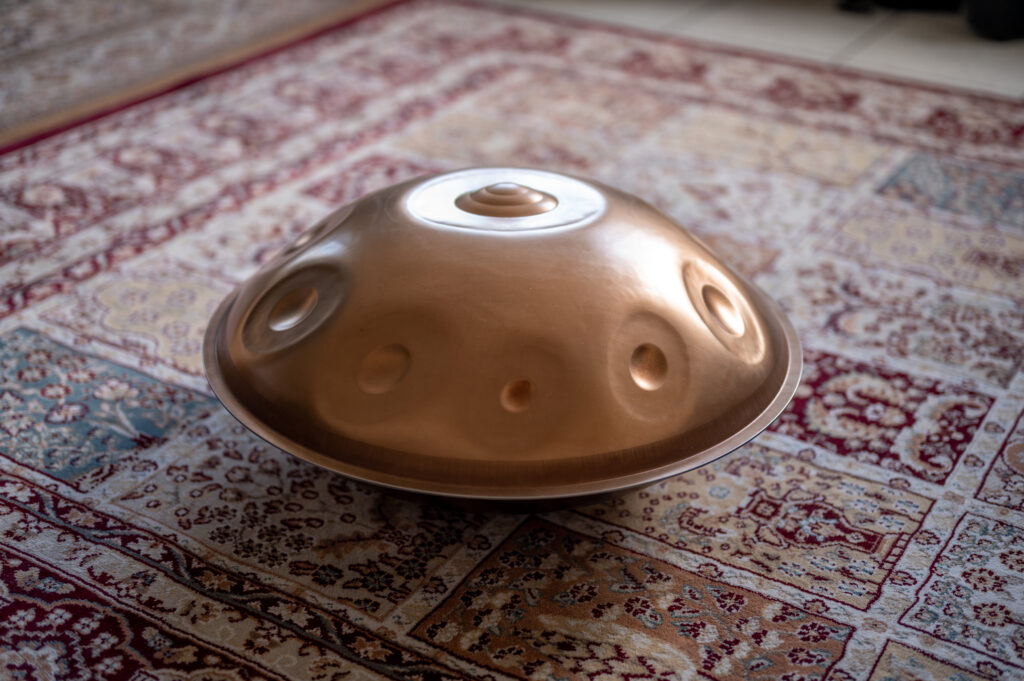
The primary quality requirement for any instrument is that it sounds beautiful and clear.
Fortunately, you can determine this even as a beginner by arming yourself with some knowledge and training your ear.
Pay attention to the following criteria:
For a deeper look at what separates a premium instrument from a mediocre one, read: What makes a premium handpan?
The price tag can be revealing. If a new handpan is excessively cheap (meaning below approximately 700 euros), it’s best not to buy it. While you might find a good-sounding used handpan below this price, it’s nearly impossible for a new one.
Creating a single handpan takes 4-6 months of work by experienced craftsmen. Mastering the handpan-making technique requires many years of experience and is quite repetitive, so few have the capability.
Thus, finding a handpan below 700 euros that sounds clear, is well-tuned, durable, and enjoyable to play is nearly impossible. If you want to be certain, we recommend not purchasing any handpan under 1,000 Euros.
Read more about why cheap handpans disappoint: What’s the difference between cheap and affordable handpans?
The scale might be strange or unusual, but if you truly love it, go ahead and choose it. If you love its sound, you’ll love playing the handpan as well.
However, make sure this decision is within a framework—don’t start with an exotically tuned handpan.
It’s crucial to consider the emotional connection you form with the instrument. Try out the handpan, and as you hear its “response” and sound, you’ll feel whether it speaks to your soul, and which scale or sound feels closer to you.
Keep this in mind for your final decision!
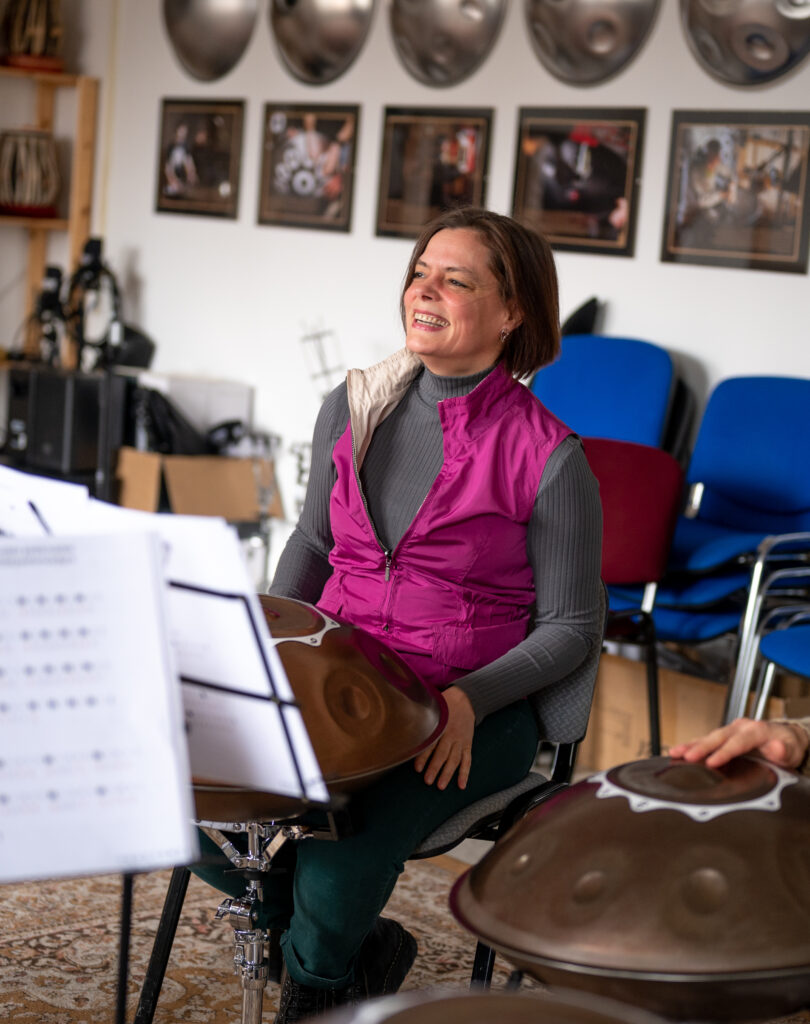
For beginners, even a handpan with the fewest number of note fields is perfectly suitable.
Choosing a handpan with 10-12 notes, or one with bottom note fields, may end up being frustrating and overwhelming. “Choice overload” can be unsettling, and as a beginner, you won’t be able to handle so many notes.
Additionally, more notes mean higher prices, even at the same quality level. Generally, each additional note field increases the price by 100-200 euros. So an 8-note handpan will be cheaper than a comparable 10-note handpan.
Therefore, a good beginner handpan is simple, with a maximum of 8 note fields plus the ding (central note). However, be aware that individual manufacturers may count notes differently. Some include the ding (central note) in the count, while others indicate it with a plus sign. So a 7+1 and 8-note handpan could both be considered 8-note, but in the latter case, the ding may not be separately marked, meaning it actually has 9 notes.
For a full explanation of how note counts and layouts work, read: Handpan notes explained: understanding layouts and scales.
For beginners, the best choice is an Ember steel handpan (a type of stainless steel), a special alloy. Its beauty is that even those less experienced can produce a beautiful sound. It has no crosstalk, its sound is heartwarming, and it requires little maintenance. It is particularly suitable for meditative, melodic playing.
Stainless steel handpans are also good for beginners, similar to Ember steel. Their sound is meditative with a long resonance (causing mild but harmonious crosstalk), perfectly suited for playing relaxation music.
For a deeper look at handpan materials and how they affect sound: Handpan shell: materials and manufacturing and our handpan material guide.
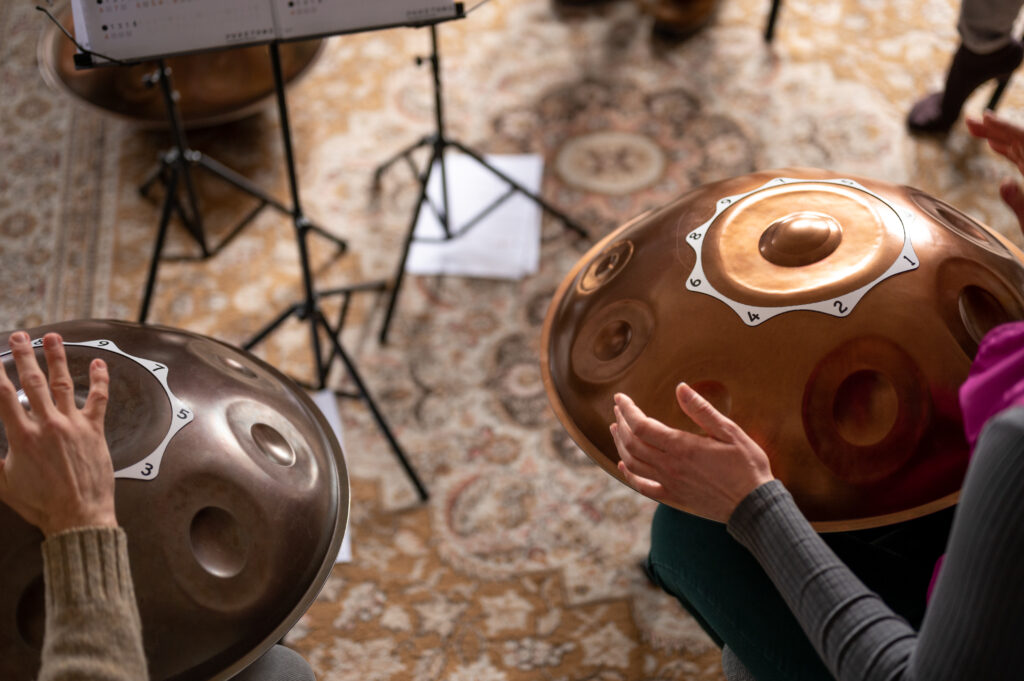
This is the central note after which the scale is named, like C in C major. Each scale has a distinctive sound and serves as a starting point, providing a sense of completeness to the songs.
However, for some handpans, the central note isn’t tonic, which can create a feeling of incompleteness or lack. This is not ideal for beginners, as they don’t have a fundamental note to rely on.
A good beginner handpan should have a tonic ding (central note) that provides a reliable “home” to which beginners can always return, knowing it will sound pleasing.
For European or Western ears, major and natural minor scales are most familiar. The vast majority of music played on the radio also uses these scales.
On the other hand, scales like the harmonic minor may sound exotic or Eastern.
This difference stems from a concept known as “complementary pairs.” Every major scale has a relative minor counterpart, and every minor scale has a relative major counterpart. These relative scales share the same notes but are ordered differently. However, the harmonic minor scale lacks this complementarity, making handpans tuned to this scale challenging for beginners.
A good beginner handpan is either in a major or natural minor scale.
An example is the Kurd scale, which typically has only 8-9 notes, but the D Kurd model, for instance, has 10. 10. Read our full guide on it: What is the D Kurd handpan scale?
The scale also influences the handpan’s mood. Major scales tend to be cheerful and joyful, while minor scales are more melancholic and hypnotic. Incidentally, the most sold handpans worldwide are those in minor scales.
Not sure which scale is right for you? Read our overview: 10 handpan scales — which one is right for you?
Frequency, a concept from physics, refers to the wavelength of sound-producing air vibrations measured in hertz (Hz) over time. The faster the vibration—meaning the shorter the wavelength or more vibrations per unit of time—the higher the pitch of the sound.
Every note has its own frequency, which, when combined harmoniously with others, creates pleasing sounds.
Handpans are typically available in two types of frequencies: 440 Hz and 432 Hz.
The 432 Hz frequency is considered healing, but it might not harmonize with other instruments.
The 440 Hz is the standard tuning, allowing play alongside other instruments. As a beginner, choose a handpan tuned to 440 Hz.
A relatively good quality handpan with 8-10 notes varies between 1,000-2,500€ depending on the brand and type. While 700/1,000 euros is the entry-level price, it’s worth investing a bit more into a handpan you can use for many years, one that stays in tune, sounds crystal clear, and provides an engaging musical experience.
Unfortunately, these qualities can’t be expected from a 700-800 euro handpan, and even a 1,000 euro one may fall short.
Additionally, if you realize later that you didn’t choose the right scale, it would be much easier to sell a mid-priced handpan at a better price. Such a handpan sounds better, is more reliable, and maintains its tuning longer. Conversely, you may not find a buyer for an inexpensive, potentially Chinese-made handpan.
Knowledgeable dealers (as opposed to large retailers) offer professional support.
Handpan manufacturers can retune the instruments later and assist with maintenance and acquiring additional tools. Learn more about what proper aftercare looks like: Handpan care
You can purchase in-store or online, provided there are enough references and contact information available.
The advantage of a physical store is the ability to try out the instrument.
In a good online shop, you’ll find videos, pictures, and precise descriptions for each handpan, and they answer your questions via email and phone. You can also check our available instruments page for in-stock handpans with detailed photos, videos, and specifications for each individual instrument.
All MAG instruments are built from Ember Steel, hand-tuned in our workshop in Győr, and come with a Lifetime Retuning Warranty — so your first handpan is also your last worry.
Not sure which scale to start with? Here are the most recommended configurations for first-time buyers:
The go-to choice for beginners. A fully diatonic D natural minor scale, warm, versatile, and immediately expressive — and backed by the largest library of tutorials of any handpan scale. Read the full D Kurd scale guide
A hexatonic minor scale (also known as Celtic or Annaziska) with a flowing, folk-influenced character. Approachable and immediately pleasing, with a slightly brighter quality than D Kurd.
The same Amara scale in a lower register — fuller in the low end, with the same folk warmth but with more weight behind it.
A distinctive scale with a Mediterranean identity. A strong choice for players who know they are drawn to modal or exotic tonalities.
Browse the full MAG range and find the right first instrument for your playing style and budget.
If you decide you want only the best and are willing to invest, you can play on a beautifully sounding handpan that matches your dreams.
The instruments from MAG Instruments are recognized by international makers and handpan schools, and we’re thrilled about this honor.
If you’re looking to purchase a world-class handpan, browse our webshop by clicking the button below:
To make sure we’re displaying the right prices for our instruments, please confirm your location.
