


The handpan is an incredibly rich-sounding modern percussion instrument.
It’s possible to play both rhythm and melody on it, and anyone can confidently start playing without any musical training.
Its sound is extraordinarily soothing, captivating, and unmistakable.
Discover this wonderful instrument through our article, where you’ll learn almost everything about it and, undoubtedly, feel inspired to give it a try.
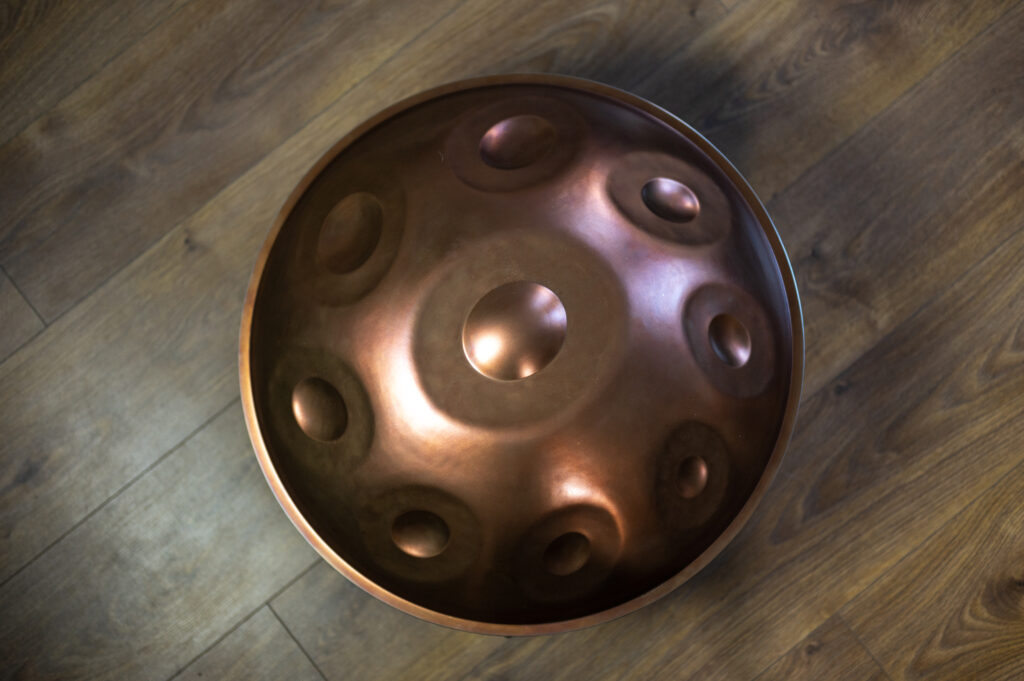
A handpan is a modern, metal, lens-shaped percussion instrument played with both hands.
Its shape resembles a UFO, which is why it’s sometimes called a “UFO drum,” though it isn’t a drum in the traditional sense (as it lacks a membrane).
The handpan belongs to the idiophone family of instruments, meaning the sound-producing vibrations are created by the body of the instrument itself (similar to bells, gongs, or wooden blocks).
Handpans are made from a variety of steel materials, in numerous sizes and tunings, but all share a meditative, hypnotic sound. Once you’ve heard a handpan play, you’ll never forget its magical, otherworldly, soul-soothing melody.
+1 – You can practice at home anytime since the handpan isn’t too loud, so you’re unlikely to disturb your neighbors. In fact, they might only comment when you stop playing 😉
The first handpan was crafted in Switzerland in 2001 by its creators, who named it the Hang®, a word meaning both ‘hand’ and ‘hillside’ in Bernese German dialect.
The creator couple, Felix Rohner and Sabina Schärer of PANArt, embarked on this new instrument’s development inspired by the idea of traveling musician Reto Weber. Weber sought an instrument similar to a steel drum (or steelpan) that could be played with hands (as opposed to the steel drum, which is played with mallets).
The couple, originally steel drum makers, designed the instrument drawing inspiration from existing instruments. They blended the forms and sounds of the Caribbean steelpan, instruments from Indonesian gamelan orchestras, the Thai gong, and the Indian ghatam, a type of clay pot.
In the four years following its first public exhibition at Musikmesse in Frankfurt, 45 different models and 5,000 Hang® instruments were produced in the PANArt workshop. The new instrument’s popularity skyrocketed, resulting in waitlists that spanned months and even years. This demand became so intense that those desiring a Hang® had to send handwritten letters of motivation and sometimes waited years for a response.
The couple patented the Hang® name, but not the instrument itself.
This led to a scenario where, a few years later, other manufacturers introduced their own versions of Hang®-like instruments to the market. The term “handpan” first appeared online in 2007.
Although PANArt officially states that the Hang® is neither a handpan nor a steelpan, due to its distinct tuning, its sound and playing technique are remarkably similar to those instruments.
Thus, the handpan can be considered an umbrella term that encompasses a wide variety of instruments with diverse sizes, tunings, and sound richness.
Nowadays, there are hundreds of manufacturers producing these instruments worldwide in varying quality, and they are even available in cheap Chinese online stores. However, we strongly advise against ordering mass-produced handpans, as their sound quality is often poor (frequently out of tune), and they cannot be tuned, likely leading to disappointment and discouragement from playing music.
Premium international manufacturers have a significant responsibility in preserving the musical integrity of the handpan.
The MAG Instrument team embarked on this journey, and as passionate musicians ourselves, we are incredibly pleased that the instruments crafted in our workshop are sought after and recognized worldwide.
Our philosophy is that only a high-quality, impeccably tuned instrument can deliver the musical experience that brings joy and motivates individuals to make music.
That’s why we craft each handpan with great care, individually by hand, ensuring premium quality and providing professional support for every instrument.
Listen to one of our founders and musician, Péter Bognár, play a handpan crafted by MAG Instrument:
Creating a handpan is a time-consuming and complex process that requires years of experience and expertise. This is why even an entry-level handpan can be quite expensive.
At MAG Instruments, we craft handpans by hand with the utmost attention and passion. As musicians ourselves, we understand precisely what makes an instrument sound so beautiful.
It all begins with meticulous scale design, which involves more than just arranging tone fields on the instrument’s surface. Each tone field, including the central ding, must be carefully sized and proportioned to achieve the desired resonance. Perfecting a scale takes hundreds of experiments to ensure the ideal balance of tones and just the right amount of crosstalk between them.
The most labor-intensive aspects are forming and tuning the tone fields, which require a high degree of precision and patience. We employ a specialized tuning methodology for this purpose.
Given that the handpan is made of steel, it is inherently challenging to work with. Additionally, tuning requires an extremely refined and precise technique, as the depth and shape of the tonefields must be crafted to the precision of tenths of a millimeter.
We use various specialized electric, pneumatic and manual hammers, known as “strikers,” for this task.
The purity of the tones is checked with an electronic device specifically designed for this purpose, and we perfect each handpan until its sound quality reaches 100%.
Take a sneak peek into the MAG Instrument workshop:
A handpan is made by fusing together two steel “shells,” which are then shaped to form indentations known as “tone fields.” At the top center of the handpan is the starting tone field (Ding), which features a small protrusion in its center.
On the bottom of the handpan, there’s an indentation known as the Gu. This functions as a “Helmholtz resonator,” contributing to the instrument’s characteristic, enchanting sound.
The material can be:
It weighs between 2.5 to 4.5 kg (5.5 to 10 lbs) and measures 45 to 65 cm (about 18 to 26 inches) in width.

A scale is a series of musical notes that can be complete, like on a piano (C, D, E, F, G, A, B), or partial, as is usually the case with a handpan (D3/ A3, A#3, C4, D4, E4, F4, G4, A4, C5).
This means that not all seven fundamental notes are present on a handpan, so you can only play in specific scales. These can vary widely and fundamentally influence the mood of the handpan’s sound.
Manufacturers give a diverse range of names to the various scales (Kurd, Amara, Pygmy, etc.), but the essence is that minor scales typically have a more melancholic tone, major scales are more cheerful, and mixed scales often have an exotic or Eastern sound.
The note attached to the scale name (e.g., D, E, F#) indicates the key to which the handpan is tuned, such as D Kurd, F# Pygmy etc.
Listen to how the different scales sound:
D Kurd G2 Desert Eagle 18 Handpan E Amara Mutant 20
Handpans typically contain 8-11 notes, but there are also so-called “mutant” handpans with up to 22 notes, featuring additional tone fields around the ding, and also perhaps on the underside.
For beginners, the D Kurd scale is the most suitable because:
Handpans can be differentiated by their physical size, number of notes, and tuning:
Larger handpans (with larger tonefield) produce deeper sounds, while smaller ones have higher pitches. Handpans with more notes are generally larger in size.

The handpan is a remarkably young instrument, yet it quickly exploded in popularity, with musicians eager to explore its potential. Its rapid rise in fame can be attributed in part to the internet and social media, as well as to its captivating sound. The handpan’s popularity can also be due to its “instant gratification” factor – anyone can produce sound from the instrument without prior skill and it doesn’t take long to reach a level where you can play enjoyable music..
Both hobbyists and professional musicians were able to easily and quickly exchange experiences online and at musical gatherings and festivals, which helped swiftly build and evolve a shared knowledge base and playing techniques.
A major advantage of the handpan is its versatile usability.
It sounds great alone, in a duo with another handpan, within a small ensemble, or even as part of an orchestra.
The handpan has found its place in a wide range of genres, from world music to electronic styles.
In indie and alternative music, the handpan is used for its unmistakable, unique, and enchanting sound.
In pop music, it is combined with both acoustic and electronic instruments to add a special flavor to the music.
It provides a more natural and human-like sound to electronic music as well.
The handpan is a favored instrument in ambient and chillout music due to its meditative and relaxing sound.
It has its place in world music thanks to its distinctive sound. By combining modern and traditional musical elements, it pairs excellently with traditional instruments like the Aboriginal didgeridoo, Indian sitar, or tabla.
The handpan is also a favorite in fusion music due to its diverse sound palette.
Its soul-soothing sound makes it a vital accompaniment for sound baths, sound therapies, and meditations.
In TV shows, series, especially fantasy and nature films, documentaries, and travel films, handpan music can serve as background music, thanks to its mystical, rich, and captivating sound.
However, the handpan sounds incredible not only in ensembles but also on its own.
It offers a unique musical experience as a solo instrument at festivals and smaller events, and is great for improvisation.
Handpans are no longer limited to acoustic instruments; the evolution of technology has brought about the arrival of the digital handpan.
The most versatile and usable of these new age handpans is Neotone.
With its innovative design and advanced technology, Neotone opens doors for creative exploration while maintaining the essence of the instrument. It also doesn’t cost more than a regular, acoustic handpan. Also, Neotone’s sound library is mostly based on MAG handpans, so it’s definitely worth a listen.
The best option is to purchase directly from a handpan specialized manufacturer at a music store, where you can also try out the instrument.
At MAG Instruments, you have this opportunity, and we offer all kinds of professional support (from tuning to maintenance and consultations). We guarantee that the handpans we craft with great love sound beautiful and crystal clear.
We only recommend buying online if you can be 100% assured of the instrument’s origin and quality, such as by contacting the manufacturer before purchase and receiving professional support, as well as a guarantee for a refund in case of any defects.
Where Not to Buy a Handpan:
It’s worth going into a bit more detail about pricing, as it can be a significant constraint for many. We understand that not everyone can afford to spend 3,000-5,000 euros on a premium instrument.
And of course, you don’t have to; you can acquire your first handpan at a much more affordable price!
However, there is a price point below which it simply isn’t worth buying a handpan, as the sound may be off and distorted, leading to a frustrating experience that ends with the instrument collecting dust in a closet.
Even if you’ve never played music before, it’s not advisable to purchase a new handpan for less than €700.
In such cases, before committing yourself to any instrument, we recommend instrument rental or participating in a few-hour workshop or online courses before investing. This way, once you’ve learned the basics, you’ll know if you want to continue and whether it’s worth investing in a high-quality instrument or perhaps purchasing a branded but used handpan.
Starting with a tongue drum isn’t a bad idea either. Its sound is similar to a handpan but more metallic, played with mallets, and you can acquire a nice-sounding instrument relatively cheaply (starting at around €50).
A larger-sized, RAV-type tongue drum, priced at approximately €200-€300, can also be played by hand, similar to a handpan.

Click here to try playing the handpan with your mouse clicks, it will likely spark your interest in the real thing!
If you’ve fallen in love with the handpan or are simply curious, visit our website to virtually explore our store and get to know our handpans.
If you’re interested in the world of handpans, request our newsletter!
We promise not to spam you or send daily offers—our newsletters focus on the love of music and handpans, and are to be sent roughly once per month.
To make sure we’re displaying the right prices for our instruments, please confirm your location.
